Disclosure: this article contains affiliate links. If you buy through them, AliCoinsDeals may earn a commission at no extra cost to you.
Clothes and shoes are some of the best value on the platform, but they are also where the most returns happen, usually for one reason: the fit. A little prep turns a guessing game into a confident order, and pairs nicely with the savings you find in our promo codes hub.
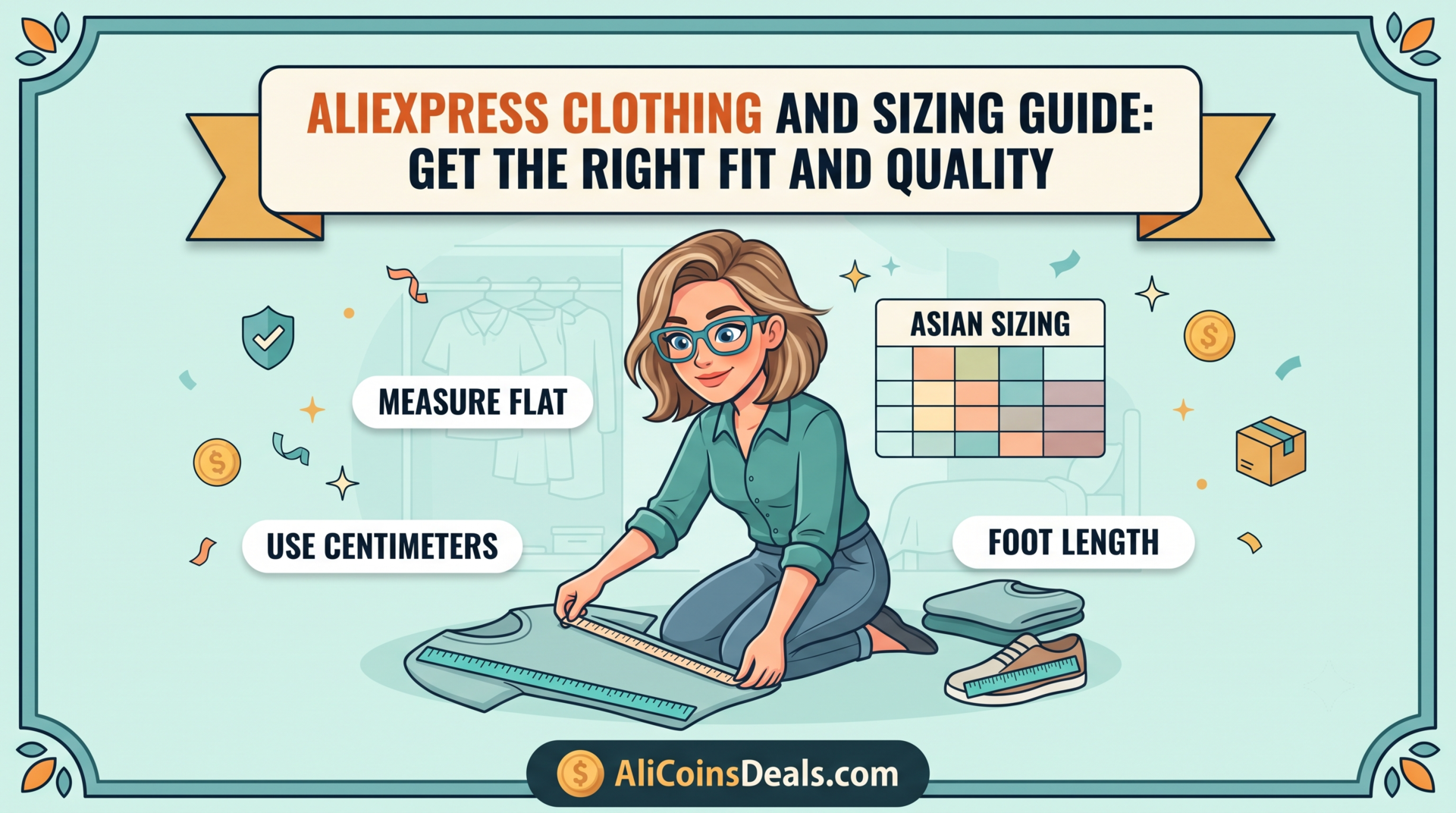
If you are asking “does AliExpress run small?”, the short answer is yes, often. A lot of AliExpress clothing uses Asian sizing, which generally runs smaller than US and EU sizing for the same letter label. The reliable fix is to ignore the S/M/L letter entirely and buy from the listing’s own measurement chart instead. This guide shows you exactly how.
Key Takeaways
- AliExpress clothing frequently uses Asian sizing, which tends to run smaller than US and EU sizing for the same letter.
- Ignore the S/M/L label and buy from the listing’s centimeter size chart, matched to your own body measurements.
- A garment you already own that fits well is your best reference: measure it flat and compare.
- For shoes, match the foot-length in centimeters in the chart, not the numeric size, and skip branded sneakers sold far below retail.
Why does AliExpress clothing run small?
AliExpress clothing often runs small because much of it is made for the domestic Asian market, where standard sizing is built around smaller average body proportions than US and EU charts. So a “Large” from one seller can fit like a US Medium or even a Small. The letter on the tag is not a universal standard, and it varies seller by seller.
This is not a flaw or a scam. It is simply a different sizing system. Sellers based in mainland China, Vietnam, and elsewhere in the region pattern their garments to local norms, then slap a familiar letter label on the export listing. Two stores can both call an item “M” and cut it to completely different measurements.
The practical takeaway is to stop trusting the letter. A label tells you almost nothing on its own. What actually predicts fit is the centimeter measurements in the listing’s size chart, which we will get to next.
How do I find my size on AliExpress?
The reliable method is to read the listing’s own size chart in centimeters and compare it to your body measurements, not to convert a letter. Nearly every clothing listing includes a chart, usually as an image in the product photos or a table lower down the page. It lists chest (or bust), waist, hips, shoulder, sleeve, and total length per size, in centimeters.
To use it well, you need your own numbers. Grab a soft tape measure and record these, wearing light clothing:
Measure your body
- Chest / bust. Wrap the tape around the fullest part, under the arms, keeping it level across your back.
- Waist. Measure the narrowest part of your torso, usually just above the navel. Don’t suck in.
- Hips. Measure the fullest part of your seat, with feet together.
- Inseam / length. For trousers, measure from the crotch seam down to where you want the hem.
Measure a garment you already own
This is the trick that beats every conversion chart. Take a shirt, dress, or pair of trousers from your wardrobe that fits exactly how you like, lay it flat, and measure it.
- Chest (flat). Measure pit to pit across the front, then double it for the full circumference.
- Length. Measure from the highest point of the shoulder straight down to the hem.
- Trouser waist (flat). Measure across the waistband edge to edge, then double it.
Now match those numbers to the seller’s chart. If your favorite shirt is 56 cm pit to pit and the listing’s “XL” is 54 cm, you already know it will be snug. In our experience this single habit prevents most sizing returns. It removes the guesswork that letters and conversion rules can’t.
What is the rough Asian-to-US/EU size conversion?
As a starting point, many shoppers size up one or two letters from their usual US or EU size when buying Asian-sized clothing. So a typical US Medium often shops an Asian Large or XL. But treat this only as a rough orientation, because the centimeter measurements in the chart are what decide the fit, not the conversion.
The table below is a loose guide for tops, not a rule. Always confirm against the listing’s own chart before you commit.
| Your usual US/EU size | Common Asian-label equivalent | Confirm with chart? |
|---|---|---|
| XS / EU 32-34 | S | Yes, always |
| S / EU 36 | M | Yes, always |
| M / EU 38-40 | L or XL | Yes, always |
| L / EU 42 | XL or XXL | Yes, always |
| XL / EU 44 | XXL or 3XL | Yes, always |
Why so cautious? Because two listings that both say “XL” can differ by several centimeters, and brands cut differently for slim, regular, and oversized styles. A relaxed-fit hoodie and a fitted tee labeled the same size are not the same garment. The conversion gets you to roughly the right row in the chart. The centimeters confirm it.
How do I check fabric and material quality?
Start with the composition line in the listing, which states the fabric blend, such as “95% cotton, 5% spandex” or “100% polyester.” This tells you how a piece will feel, stretch, and breathe before any photo does. Natural fibers like cotton and linen breathe well, while pure polyester can feel synthetic and trap heat, though it resists wrinkles.
Watch for fabric weight too. Better listings state a gram-per-square-meter (GSM) figure or describe the material as “thick” or “heavyweight.” A very thin, low-GSM tee can arrive semi-transparent and flimsy. If the weight is not listed, that silence is itself a small warning sign for anything you expect to last.
Then let other buyers do the testing for you. Search the reviews for words like “thin,” “soft,” “scratchy,” “see-through,” and “warm.” Real wearers describe fabric feel far more honestly than any product description. A pattern of “thinner than expected” comments is a reliable predictor of disappointment, and worth more than the listing’s adjectives.
How can I judge quality from reviews and buyer photos?
Filter the reviews to show only those with customer photos, then read the fit and quality comments underneath them. Buyer images are the closest thing to seeing the garment in person, because they show real color, drape, and construction rather than a studio shot. Listings with hundreds of detailed photo reviews give you a far more honest picture than a glossy listing with none.
When you scan photo reviews, prioritize three things:
What to read in a photo review
- Fit comments tied to body info. Reviews that say “I’m 175 cm, 70 kg, ordered L, fits perfect” are gold. They let you map the size directly to a body like yours.
- Color accuracy. Screens and studio lighting lie. Buyer photos in natural light show the true shade.
- Construction details. Look for mentions of loose threads, seam quality, zippers, and whether prints are centered.
Sort or filter by the most recent reviews where you can, since sellers sometimes change suppliers over time. A listing that was great a year ago may ship a different product today. If the reviews are all five stars but text-only with no images, treat the score as unverified rather than reassuring. If you want a fuller routine for reading a store before you buy, our guide to vetting an AliExpress seller in 60 seconds walks through the trust signals that matter most.
How do you get AliExpress shoe sizing right?
Ignore the EU or US number on the label and buy by foot length in centimeters. Shoe sizing varies even more than clothing across AliExpress sellers, so one store’s “US 9” is another’s “EU 43”. The centimeter column in the seller’s chart is the only field you can trust.
Measuring takes a minute. Stand on a sheet of paper with your heel against a wall, mark the tip of your longest toe, and measure wall to mark. Do both feet and use the longer one. Measure at the end of the day, when feet are slightly larger, wearing the socks you plan to use.
| Measured foot length | Typical EU size | Typical US (men) |
|---|---|---|
| 24.5 cm | 39 | 6.5 |
| 25.5 cm | 40-41 | 7.5-8 |
| 26.5 cm | 42 | 9 |
| 27.5 cm | 43-44 | 10-10.5 |
| 28.5 cm | 45 | 11.5 |
Use that table only as a sanity check. Asian shoe sizing often runs one to two sizes small, so the listing’s own foot-length chart overrides it every time. If a footwear listing has no centimeter chart at all, pick a different listing rather than gamble on the number.
Are branded shoes on AliExpress real?
Most AliExpress shoes are genuine unbranded or own-brand footwear, sold honestly at their own price. Branded sneakers at a fraction of retail are not. A “Nike” for $35 is a counterfeit, and sellers signal it with coded names or offers to “add the logo”. Customs can seize counterfeits, with no refund or warranty to fall back on.
The safety risk is the part most buyers miss. In February 2026 the American Apparel & Footwear Association tested 39 counterfeit apparel, footwear and accessory products, and 16 of them, or 41%, failed US and international safety standards. One contained nearly 327,000 parts per million of diethyl phthalate, more than 650 times the limit. Others failed for PFAS and bisphenol-A.
Shoes sit against your skin all day, so buy honest unbranded designs instead. The wider rules are in is AliExpress safe and legit.
What if the clothes don’t fit?
Your options depend on whether the item carries the Free Return tag. Items marked Free Return give you 15 days from delivery to send them back for any reason, including a simple wrong-size or changed-mind situation, at no shipping cost. Look for that label on the product page before you buy if fit is a worry.
Without the Free Return tag, “wrong size” remorse is a weaker position. For shoes, return postage to China can cost more than the pair. Standard Buyer Protection is built to cover items that never arrive or that do not match the listing, not items that arrived exactly as described but simply did not suit you. A seller doesn’t have to take back a correctly described item that simply fit differently.
That is why the size chart matters so much: it shifts a “doesn’t fit” problem from remorse, which is barely covered, toward “not as described,” which is covered if the garment’s real measurements clearly differ from the chart. To understand exactly where that line sits, read our full AliExpress Buyer Protection guide before you open any dispute.
How do I save on clothing with coins and codes?
Fashion listings stack discounts unusually well, which makes the right fit even cheaper once you know it. AliExpress coins can be redeemed for small per-order discounts at checkout, and they sit on top of seller sales and platform promotions. Our walkthrough on using AliExpress coins effectively shows how to build a balance worth spending.
On top of coins, seller and platform promo codes knock down the price further, especially during the big seasonal sales. We keep a refreshed list in the promo codes hub, and you can run any product link through our coin discount tool on the homepage to see the savings before you commit. Get the fit right first, then layer the discounts.
Frequently Asked Questions
Does AliExpress clothing run small?
Often, yes. Much of it uses Asian sizing, which generally runs smaller than US and EU sizing for the same letter label, so a “Large” can fit like a US Medium. The fix is to ignore the letter and buy from the listing’s centimeter size chart, matched to your own body measurements, rather than relying on the S/M/L tag.
How do I find my size on AliExpress?
Read the listing’s size chart in centimeters and compare it to your own measurements. Measure your chest, waist, and hips with a soft tape, or better still, measure a garment you already own that fits well and match those flat measurements to the chart. The centimeters predict fit far more reliably than any letter or conversion rule.
Can I return clothes that don’t fit on AliExpress?
Only easily if the item carries the Free Return tag, which gives you 15 days to send it back for any reason at no shipping cost. Without that tag, “wrong size” remorse is weakly covered, since standard Buyer Protection targets items that never arrive or do not match the listing rather than ones that simply did not suit you.
Is AliExpress clothing good quality?
It varies enormously by seller, so quality is something you verify rather than assume. Read the fabric composition, look for a stated GSM or “thick” description, and filter the reviews to photo-only entries. Listings with many detailed buyer photos and consistent quality comments are far safer bets than glossy listings with no real customer images.
Do AliExpress shoes run small?
Generally yes. Asian shoe sizing typically runs one to two sizes smaller than Western sizing, and the gap grows at larger sizes. Measure your foot heel to toe in centimeters and match that to the chart on each listing, rather than ordering your usual size number, because it varies from seller to seller.
What does “Asian size” mean on AliExpress?
It means the garment is patterned to sizing standards common in the seller’s domestic market, which are generally smaller than US and EU equivalents for the same letter. Some listings show both “Asian size” and “US size” columns in their chart. When they do, follow the centimeter figures in whichever column you choose, not the letter beside them.
What Else Should You Read Before Buying Clothes?
- Comparing platforms first? AliExpress vs Shein weighs price, quality and safety for clothing specifically.
- Buying beyond fashion? AliExpress vs Temu vs Amazon covers the wider marketplace choice.
Buying clothes and shoes on AliExpress comes down to one discipline: trust measurements, not labels. Pull your body numbers and a well-fitting garment’s flat measurements, match them to the listing’s centimeter chart, and read the fabric line and the photo reviews before you commit. For shoes, the foot-length value in centimeters is the only number that matters. Do that, and the letter on the tag stops mattering, the fit stops being a gamble, and the deals you stack on top are money well spent rather than a return waiting to happen.
Ready to unlock massive savings?
Don't pay full price on AliExpress. Use our free coin converter to find hidden discounts up to 90% off.