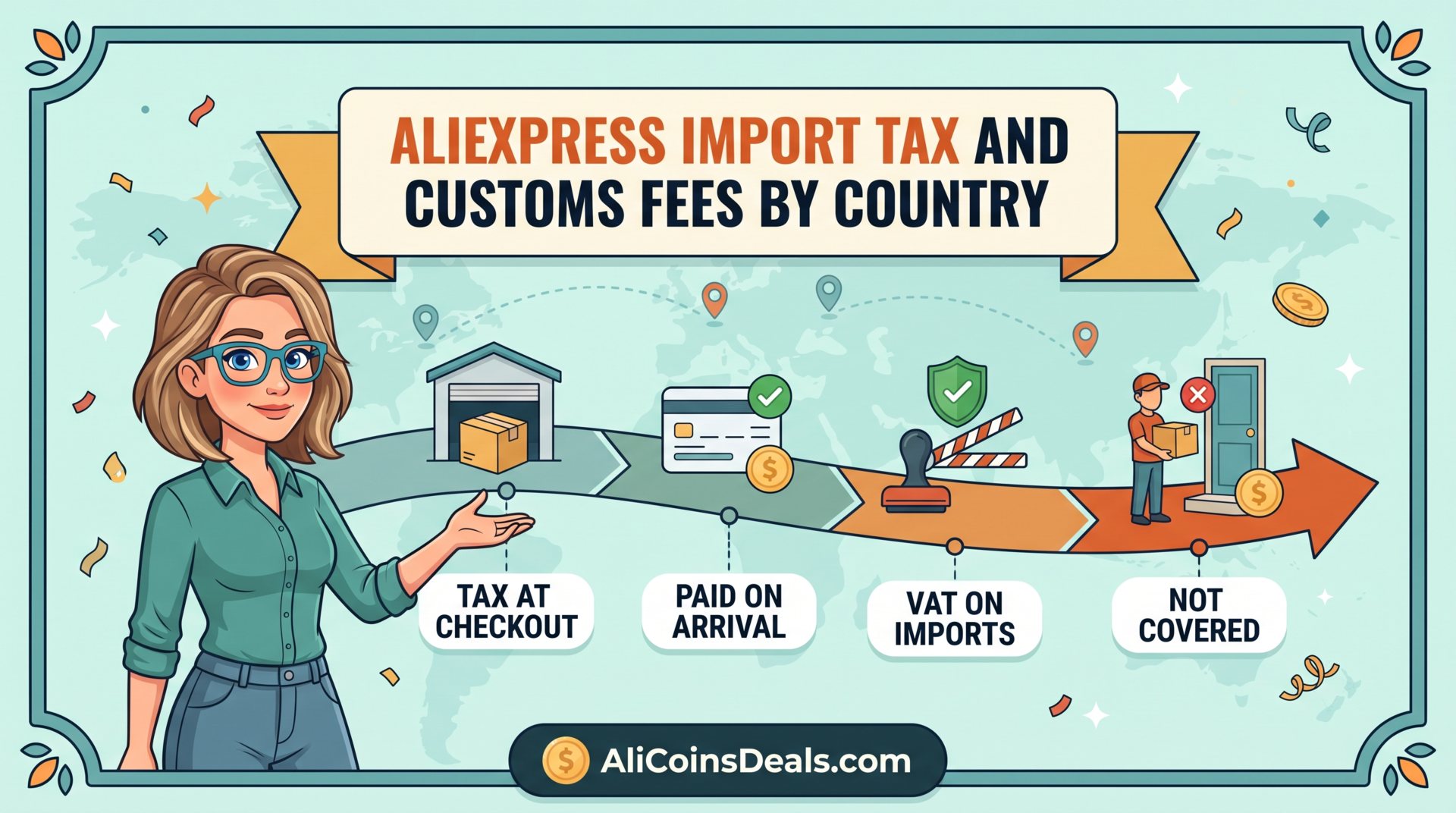
Disclosure: this article contains affiliate links. If you buy through them, AliCoinsDeals may earn a commission at no extra cost to you.
Scoring a great price with coins and promo codes feels fantastic right up until a delivery driver asks for an extra payment, or a parcel sits in customs waiting on a tax bill. Knowing how import charges work is just as valuable as the discount itself.
So do you actually pay tax on AliExpress orders? In most cases, yes. The price you see at checkout may already include your local sales tax or VAT, or you may be billed separately when the package crosses your border. Which one happens depends on three things: your country’s rules, the value of your order, and whether the seller collects tax up front. This guide explains all three.
Key Takeaways
- The “too cheap to be taxed” era is over. VAT or GST now applies to imports at almost any value, and duty relief is disappearing too.
- Tax is either collected by AliExpress at checkout or charged by the carrier or customs on arrival, rarely both for the same charge.
- The US suspended its $800 de minimis exemption for all countries on 29 August 2025, and made the suspension indefinite by regulation on 24 June 2026.
- The EU scrapped its €150 duty exemption on 1 July 2026 and replaced it with a flat €3 duty per item, running until July 2028.
- The UK still collects import VAT at checkout on consignments up to £135.
- Buyer Protection does not cover customs duties or import taxes, so budget for them separately.
How Are Import Taxes Calculated on AliExpress?
Three separate mechanisms decide what you owe, and it helps to keep them apart. The first is the de minimis threshold, a value limit below which a country waives import charges to avoid the cost of processing tiny parcels. The second is VAT or GST, a consumption tax on the goods themselves. The third is customs duty, a tariff on the import itself. Duty used to apply only to higher-value shipments, but that is changing: several major markets have now scrapped their low-value duty relief entirely.
The other half of the puzzle is who collects the money. Increasingly, the marketplace charges tax when you pay, then remits it to the government on your behalf. That is why your AliExpress total sometimes looks higher than the listed item price. The alternative is collection on arrival, where your shipping carrier or the customs office bills you (often with a handling fee on top) before they release the parcel.
Knowing which path applies to your order is the single best way to dodge a surprise. When tax is shown at checkout, there is normally nothing more to pay at the door. When it is not, plan for a possible bill later.
What Import Tax Applies in Your Country?
Rules differ sharply from one country to the next, so the figures below are starting points rather than guarantees. Thresholds and rates change often, and they can shift mid-year. The table summarizes the common cases, and the sections after it add detail for the largest AliExpress markets.
| Region | How VAT/tax is collected | Duty on low-value parcels | Typically paid at |
|---|---|---|---|
| United States | Sales tax may apply at checkout | Yes, de minimis suspended since Aug 2025 | Checkout and/or arrival |
| European Union | VAT on all imports; via IOSS up to €150 at checkout | Yes, flat €3 per item since 1 July 2026 | Checkout (VAT) / arrival |
| United Kingdom | Import VAT at point of sale up to £135 | No, relief still applies (removal by 2029) | Checkout (≤£135) / arrival |
| Australia | GST collected at checkout on goods up to A$1,000 | Duty on consignments above A$1,000 | Checkout / arrival |
| Canada | GST/HST plus provincial tax may apply | Duty varies by item and origin | Mostly arrival |
Always confirm current rates with your local customs authority, because thresholds change. The notes below are general information, not tax or legal advice, and the numbers can be out of date by the time you read them.
United States
The $800 de minimis exemption is gone. For decades it let low-value parcels enter the US duty-free. It was suspended for China and Hong Kong in May 2025, extended to all countries on 29 August 2025, and then made indefinite by regulation. US Customs and Border Protection published an interim final rule on 24 June 2026 suspending the exemption for all modes other than the international postal network. That moved it from a temporary executive order into standing regulation.
What that means in practice: every shipment under $800 now needs a formal or informal customs entry, and duty is assessed on it. Rates depend on what the item is and where it was made. Analyses of the change put the combined duty burden between roughly 10% and 50% of the item’s value. A cheap order can now land with a bill that reshapes the whole deal.
CBP has said the suspension stays until the exemption no longer jeopardizes revenue or facilitates unlawful imports. Treat it as long-term rather than a blip.
Separately from import charges, AliExpress may add state and local sales tax at checkout for US buyers, since marketplaces are generally required to collect it. That sales tax is a different thing from customs duty assessed on arrival, so on many orders you will now see both.
European Union
The EU now charges on both fronts. VAT applies to all imported goods, with no low-value free pass since the old sub-€22 exemption went in July 2021. For parcels up to €150, that VAT is collected at checkout through the Import One-Stop Shop (IOSS). This is why your AliExpress total already includes it and the package clears smoothly.
The bigger change is on duty. The €150 customs duty exemption was removed in 2026, and from 1 July 2026 the EU applies a temporary €3 customs duty per item on low-value consignments up to €150. That flat fee runs until 1 July 2028, after which normal product-based duty rates apply.
Two details catch people out. The €3 is per item, not per parcel, so a basket of ten cheap things carries ten charges. And IOSS does not collect it. IOSS still handles VAT, but the duty is a separate obligation, so a package whose VAT was prepaid can still meet a duty charge on arrival.
Above €150, standard customs duty applies as it always has, assessed on arrival.
We cover this change in depth, including the €2 handling fee and what happens after 2028, in the new EU import and customs rules for 2026.
United Kingdom
The UK is now the outlier: it still gives low-value parcels a duty break. Import VAT has applied since January 2021. For consignments valued up to £135, HMRC requires the seller to charge UK VAT at the point of sale. AliExpress collects it during checkout, and the parcel arrives without a further tax demand. Note that £135 applies to the whole consignment, not to each item in it.
Once an order exceeds £135, the rules flip. Import VAT, and potentially customs duty, are handled on arrival, typically by the courier, which may also add a clearance or handling fee before releasing your goods.
This gap is closing. At the Autumn Budget 2025 the UK government announced it will remove customs duty relief on low-value imports by March 2029 at the latest, following the EU’s direction. The consultation closed in March 2026. Until that lands, the rules above still stand.
Australia, Canada, and Beyond
Australia has run a marketplace-collection model since July 2018. The ATO requires 10% GST on imported goods with a customs value of A$1,000 or less, collected at checkout by the overseas seller or marketplace rather than at the border. Above A$ 1,000, GST and any duty are handled during importation instead. The threshold uses the customs value, so shipping and insurance do not count toward it.
Canada charges GST/HST plus provincial taxes, usually assessed on arrival with a carrier handling charge on top. The CBSA applies 5% GST to mail imports above a CAN$20 exemption, with duty rates varying by item type and country of origin, a low bar that catches most AliExpress orders. Plenty of other countries run comparable systems with their own thresholds and rates.
Wherever you are, the safe move is the same: verify the current rules with your own customs or tax authority before assuming an order is tax-free. A rate that was right last year may not be right today.
Does AliExpress Collect Tax at Checkout?
Often, yes, especially in the EU, UK, and Australia, where low-value VAT or GST is increasingly built into the price you pay. When the tax is collected at checkout, you will usually see it as a separate line in your order summary before you confirm payment. That collected amount is then passed to the relevant government, and your parcel should clear customs without a fresh bill at the door.
The cleanest way to spot this is to check the order total carefully at checkout. If a tax or VAT line is itemized, the charge is handled, and you can match it against the coin discount tool on the homepage to confirm your final price after savings. If no tax line appears, do not assume the order is tax-free; it may simply mean collection happens later on arrival.
This is also where Choice listings and IOSS-registered sellers earn their keep. Because they tend to prepay or collect VAT correctly up front, your package is less likely to be held for an unexpected charge.
Does Buyer Protection Cover Customs Fees?
No. AliExpress Buyer Protection guards against problems with the order itself, such as a parcel that never arrives or an item that does not match its description. It does not cover import duties, VAT, or customs handling fees. Those charges are levied by your government, not the seller, so the platform has no power to waive or refund them. Our Buyer Protection guide covers exactly what does and does not fall inside the policy.
That distinction matters when you budget. A refund for a faulty product returns the price you paid AliExpress, but any customs fee you already settled with the courier is a separate transaction with a separate party. Treat import charges as a real cost of buying from overseas, the same way you would factor in shipping.
If you are still weighing up whether overseas ordering is worth it at all, our look at whether AliExpress is safe and legit puts the platform’s protections in context.
How to Avoid Surprise Customs Charges
You cannot make a legitimate tax disappear, but you can avoid being blindsided by one. The habits below keep nasty doorstep surprises to a minimum and let you compare offers honestly.
Check Whether Tax Shows at Checkout
Before you pay, read the order summary line by line. A visible VAT, GST, or tax line usually means collection is already handled and nothing more is owed on arrival. No line does not automatically mean tax-free, so factor in a possible later bill, especially for higher-value orders.
Prefer IOSS-Registered or Choice Listings
In regions that tax low-value imports, listings where VAT is prepaid at checkout (commonly IOSS-registered sellers and Choice items) clear customs more predictably. You pay the tax once, up front, and avoid courier handling fees that can dwarf the tax itself on cheap parcels.
Watch Your Order Value Around Duty Thresholds
Thresholds still matter, but they have moved. The UK’s £135 line is the clearest one left: stay under it and VAT is handled at checkout with no duty. In the EU the €150 line now separates the flat €3-per-item duty from standard product-based duty, so crossing it changes which duty applies rather than switching duty on. In the US there is no low-value line left at all.
Where a threshold does exist, a single big basket can tip over it and trigger duty plus a handling fee. Just keep it honest, because deliberately undervaluing a parcel is the seller’s choice to make falsely, not yours, and it can cause problems if customs inspects it.
Time Bigger Buys Sensibly
If you are planning a large haul around a major sale, build the likely tax into your budget rather than the sticker price. Our 2026 sale calendar helps you plan purchases, and pairing that with a realistic tax estimate keeps the final number from catching you off guard.
Frequently Asked Questions
Do I have to pay tax on AliExpress orders?
Usually, yes. Most countries now tax imports, including low-value ones, after older exemptions were scaled back. Sometimes AliExpress collects the tax at checkout and you owe nothing more; other times your carrier or customs office bills you on arrival. The exact rule depends on your country and your order’s value.
Does AliExpress collect VAT at checkout?
Often, in regions like the EU, UK, and Australia where low-value VAT or GST is built into the price. When it is collected, you will see a tax line in your order summary and the parcel clears customs without a further demand. Always check the summary, because not every order shows tax at checkout.
Why did I get a customs bill after delivery?
Because tax or duty was assessed on arrival rather than at checkout. This is common for higher-value orders above a country’s duty threshold, or for parcels where VAT was not prepaid. Carriers often add their own clearance or handling fee on top, which is why the bill can feel larger than expected.
Does Buyer Protection cover customs fees?
No. Buyer Protection covers issues with the order, like non-delivery or items not as described, but never import duties, VAT, or customs handling charges. Those are set and collected by your government, not the seller, so AliExpress cannot refund or waive them. Budget for them as a separate cost of overseas shopping.
Can I avoid import tax by choosing a cheaper item?
Not any more, in most places. The US suspended its $800 de minimis exemption in August 2025 and the EU scrapped its €150 duty relief on 1 July 2026, so a low price no longer keeps a parcel out of scope. The UK’s £135 consignment threshold is the main exception still standing, and it is scheduled to go by 2029. VAT or GST applies regardless of how cheap the item is.
Import tax is one of those costs that feels unfair only when it arrives unannounced. Learn the three mechanisms behind it: de minimis thresholds, VAT or GST, and customs duty. Work out whether your country collects at checkout or on arrival. Do that and the final price stops being a mystery.
Then keep four habits. Check the order summary before you pay, and screenshot it, because that screenshot is what makes a wrongly collected duty refundable. Lean toward listings that prepay tax. Watch your order value near duty thresholds. And verify the current rules with your local customs authority, because they change more often than anyone would like.
US buyers have one extra layer to know about on children’s goods, where compliance certificates now have to be filed at the border. That is covered in buying kids’ items on AliExpress.
Ready to unlock massive savings?
Don't pay full price on AliExpress. Use our free coin converter to find hidden discounts up to 90% off.