Disclosure: this article contains affiliate links. If you buy through them, AliCoinsDeals may earn a commission at no extra cost to you.
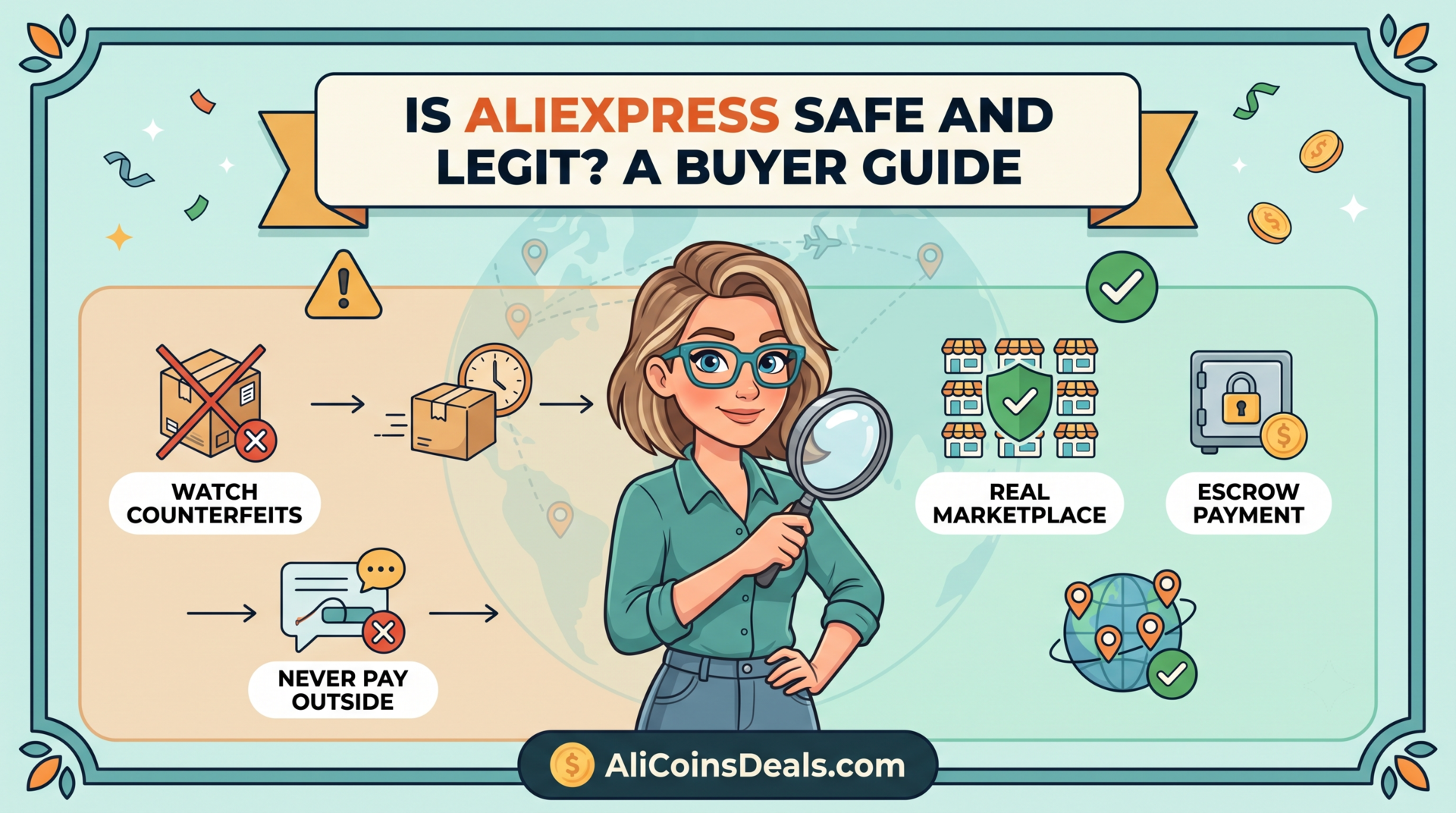
Yes, AliExpress is a legitimate company and a safe place to shop in 2026, as long as you understand how it works. It is a real, established marketplace owned by Alibaba Group, and a built-in Buyer Protection system holds your payment in escrow until your order arrives as described. Just keep one thing in mind. AliExpress is a marketplace of thousands of independent sellers, not a single store, so a few smart habits make all the difference.
This guide explains exactly why AliExpress is legit, where the real risks are, and how to shop so your money stays protected from checkout to delivery.
Key Takeaways
- AliExpress is legit. It is a real global marketplace owned by Alibaba Group, launched in 2010, and shipping to more than 200 countries and territories.
- It is a marketplace, not a single shop. Thousands of independent sellers list here, much like Amazon Marketplace or eBay, so safety depends on the seller and on using Buyer Protection.
- Your money sits in escrow. AliExpress holds your payment and refunds you if an item never arrives or does not match its listing.
- The real risks are avoidable. Counterfeits, slow shipping, customs fees, and off-platform payment requests are the main things to watch, and each one has a simple defense.
Is AliExpress a legitimate company?
Yes. AliExpress is a genuine global retail marketplace that launched in 2010 and is owned by Alibaba Group, one of the largest e-commerce companies in the world. It runs as part of Alibaba’s international commerce business and ships to more than 200 countries and territories. That makes it one of the most widely used shopping platforms on the planet.
The key thing to understand is the business model. AliExpress does not make or sell products itself. Like Amazon Marketplace or eBay, it is a platform that connects you with thousands of independent third-party sellers, most of them based in China. So when people ask whether AliExpress is a scam, the honest answer is no. The platform is real and the vast majority of orders arrive exactly as described. What varies is the individual seller, which is why the rest of this guide matters.
So is AliExpress actually safe to buy from?
The platform itself is safe. The risk, when there is one, comes from individual sellers, and that is exactly what AliExpress Buyer Protection is built to neutralize. Every payment runs through an escrow system, so your money is not released to the seller until you confirm your order arrived in good condition.
Think of it the same way you think about Amazon or eBay. Nobody calls eBay a scam because a single seller shipped a bad item, because the marketplace has systems to make it right. AliExpress works the same way. The platform is the safety net, and the seller is the variable. Choose carefully, lean on the protection built into checkout, and the odds are firmly in your favor.
How does AliExpress keep your money safe?
The safety net is Buyer Protection, and it rests on one mechanism: escrow. AliExpress holds your payment and only releases it to the seller after you confirm the order arrived as described, or after the protection window closes. If an item never shows up, or turns up wrong, damaged, or counterfeit, you can open a dispute and claim a refund within a set window after delivery.
Those guarantees, item not received, item not as described, and a time-boxed dispute window, are what make the platform safe to use in practice. The catch is that the whole system runs on deadlines, and missing one means losing your protection. For the exact timeframes, what is and is not covered, and how to win a claim, read our complete guide to how AliExpress Buyer Protection works.
What about all the negative reviews?
Search for AliExpress on a review site and you will find plenty of one-star stories, which can look alarming at first. Two things put that in perspective. First, huge third-party marketplaces always collect a pile of complaints, because every dispute with any of their millions of sellers lands in one place. Amazon and eBay score similarly on the same review platforms for exactly this reason.
Second, the complaints cluster around a predictable few issues: slow shipping, a product that did not match its photos, or a refund that took longer than expected. Those are seller and logistics problems, not signs that the platform is stealing money. Read the negative reviews as a map of what to watch for, then use Buyer Protection to cover yourself, rather than as a reason to stay away.
What is the EU doing to make AliExpress safer? (2026 update)
Regulators are actively pushing AliExpress to tighten up, which is good news for buyers. In June 2025, the European Commission made a set of AliExpress commitments legally binding under the Digital Services Act. Those commitments require four things: better detection and removal of illegal products, closer seller tracing, improved complaint handling, and more advertising transparency.
On the same day, the Commission issued preliminary findings that AliExpress had not done enough to limit the spread of illegal goods such as counterfeits and unsafe items.
Those findings became a penalty. In July 2026 the Commission fined AliExpress €550 million for breaching the Digital Services Act. It concluded the platform had failed to properly assess and mitigate the risk of illegal, unsafe and counterfeit products reaching buyers. It is the largest DSA fine issued so far.
Read that honestly, because it cuts both ways. A fine of that size confirms the problem is real and was not fixed voluntarily, so counterfeit and unsafe listings deserve genuine caution rather than a shrug. But it also shows one of the world’s strictest regulators actively forcing change, with binding commitments and financial consequences behind them. The platform is under more pressure to improve than at any point in its history. That is a reason for cautious optimism, not for assuming the problem is already solved.
What are the real risks, and how do you avoid them?
Most bad AliExpress experiences trace back to the same short list of risks. None of them should scare you off, because each has a simple defense.
| Risk | What it looks like | How to avoid it |
|---|---|---|
| Counterfeit goods | “Designer” or big-brand items at impossible prices | Buy generic or unbranded items, and treat brand-name bargains with deep suspicion |
| Slow shipping | Delivery drags on for weeks and tracking goes quiet | Pick Choice items and check the delivery date shown before you buy |
| Customs and import fees | An unexpected duty or tax bill when the parcel arrives | Know your country’s import threshold and budget for fees on larger orders |
| Off-platform payment | A seller asks you to pay by bank transfer, PayPal, or app | Never pay outside AliExpress checkout, because it voids Buyer Protection instantly |
| Poor quality | The item works but feels cheaper than the photos suggested | Read recent buyer reviews with photos and check the store rating before ordering |
The single most dangerous one is off-platform payment. Buyer Protection only exists inside AliExpress checkout, so the moment money leaves the platform, your safety net disappears completely. No legitimate seller needs you to pay any other way.
Which categories carry the most risk?
Risk isn’t spread evenly across the catalogue. A phone case that disappoints costs you a few pounds; a bad charger can start a fire, and contaminated cosmetics can harm your skin. Four categories deserve their own checks before you buy:
- Chargers, cables and mains electronics. The one cheap buy that can physically hurt you. See are AliExpress chargers safe? for how to read CE, UL and FCC marks and spot a fire-risk fake.
- Cosmetics and skincare. Counterfeit makeup has tested positive for lead, arsenic and mercury. Our guide to whether AliExpress makeup is safe covers what to buy and what to avoid entirely.
- Jewellery. Lead, cadmium and nickel are real risks in unmarked “alloy” pieces. Is AliExpress jewellery safe? lists the metals that are genuinely safe to wear.
- Electronics generally. Specs are routinely overstated and clones are common. How to buy electronics on AliExpress walks through vetting, spec-reading and the voltage and radio-band traps.
For everything else, the 60-second seller check covers most of the risk in a single sweep.
What red flags should you watch for?
A few warning signs reliably separate a risky listing from a safe one. If you spot these, slow down:
- A seller asks you to complete payment or move the conversation outside AliExpress.
- A big-brand product, like a designer bag or flagship phone, is priced far too low to be real.
- The store is brand new, has very few sales, or a low positive-feedback rating.
- The listing has no buyer photos and only a handful of vague, five-star reviews.
- A seller pressures you to click “Confirm Receipt” before your item arrives, which ends your protection early.
A trustworthy listing usually looks the opposite: an established store with thousands of orders, a high feedback score, and recent reviews that include real customer photos.
How to shop safely on AliExpress: a checklist
Put it all together and safe shopping comes down to a handful of habits:
- Favor “Choice” items. They are fulfilled through AliExpress directly, so they ship faster, track more reliably, and refund more smoothly.
- Check the store before you buy. Look for a high positive-feedback percentage, a long track record, and recent photo reviews.
- Pay only inside AliExpress. Use a credit card or PayPal at the official checkout, and never agree to pay a seller directly.
- Know your deadlines. Note the delivery window and the dispute window, and never confirm receipt until the item is in your hands and checked.
- Film an unboxing for valuable orders. One continuous video is the strongest evidence if you need to open an “item not as described” dispute.
- Keep expectations realistic. Prices are low because you are buying direct from manufacturers, so allow for longer shipping and the occasional miss.
Once you are confident the platform is safe, the fun part is paying as little as possible for what you want. Our guide to using AliExpress coins effectively and our regularly updated promo code roundups show you how to stack discounts at checkout.
Frequently Asked Questions
Is it safe to use my credit card on AliExpress?
Yes. AliExpress uses encrypted, industry-standard checkout, and paying by credit card adds a second layer of safety. If a dispute ever goes wrong inside the platform, your card issuer can step in with a chargeback as a last resort. Just make sure you pay only through the official AliExpress checkout.
Will I get my money back if my order never arrives?
Yes, this is the core promise of Buyer Protection. If your package does not arrive within the guaranteed delivery window, you can open a dispute and claim a full refund. Your payment stays in escrow the whole time, so AliExpress can return it to you instead of releasing it to the seller.
Is AliExpress legit for branded or designer items?
The platform is legit, but genuine designer goods are rare here, and a brand-name item at a tiny price is almost always counterfeit. AliExpress shines for generic, unbranded, and hobbyist products. If you want authentic branded electronics or fashion, buy from an official brand store or another retailer instead.
Why does AliExpress have such low review scores?
Large marketplaces concentrate every seller complaint in one place, so the scores look harsh. Amazon and eBay rank similarly on the same review sites. Most negative reviews are about slow shipping or a single seller, not platform-wide fraud, so weigh them as cautions rather than dealbreakers.
Is AliExpress safe for buying electronics?
For cables, accessories, gadgets, and components, yes, and many shoppers buy them routinely. Stick to well-reviewed stores, read recent photo reviews, and be cautious with expensive branded electronics, where counterfeits are most common. Buyer Protection still covers you if an item arrives faulty or not as described.
Does AliExpress sell my personal data?
AliExpress collects shopping data like any major retailer and is bound by privacy rules such as the GDPR in the European Union. To limit your exposure, share only the details an order needs, check out inside the app, and avoid saving payment information you would rather not store.
AliExpress is a legitimate, safe marketplace when you treat it like what it is: a global platform full of independent sellers, backed by genuine Buyer Protection. Stick to well-rated stores and Choice listings, keep every payment inside the platform, watch your dispute deadlines, and stay realistic about shipping times. Do that, and the vast majority of orders arrive exactly as promised, at prices the high street cannot touch.
Whether it is still worth it after the 2026 import-charge changes is a separate question, and one we answer with the numbers in is AliExpress still worth it.
Ready to unlock massive savings?
Don't pay full price on AliExpress. Use our free coin converter to find hidden discounts up to 90% off.