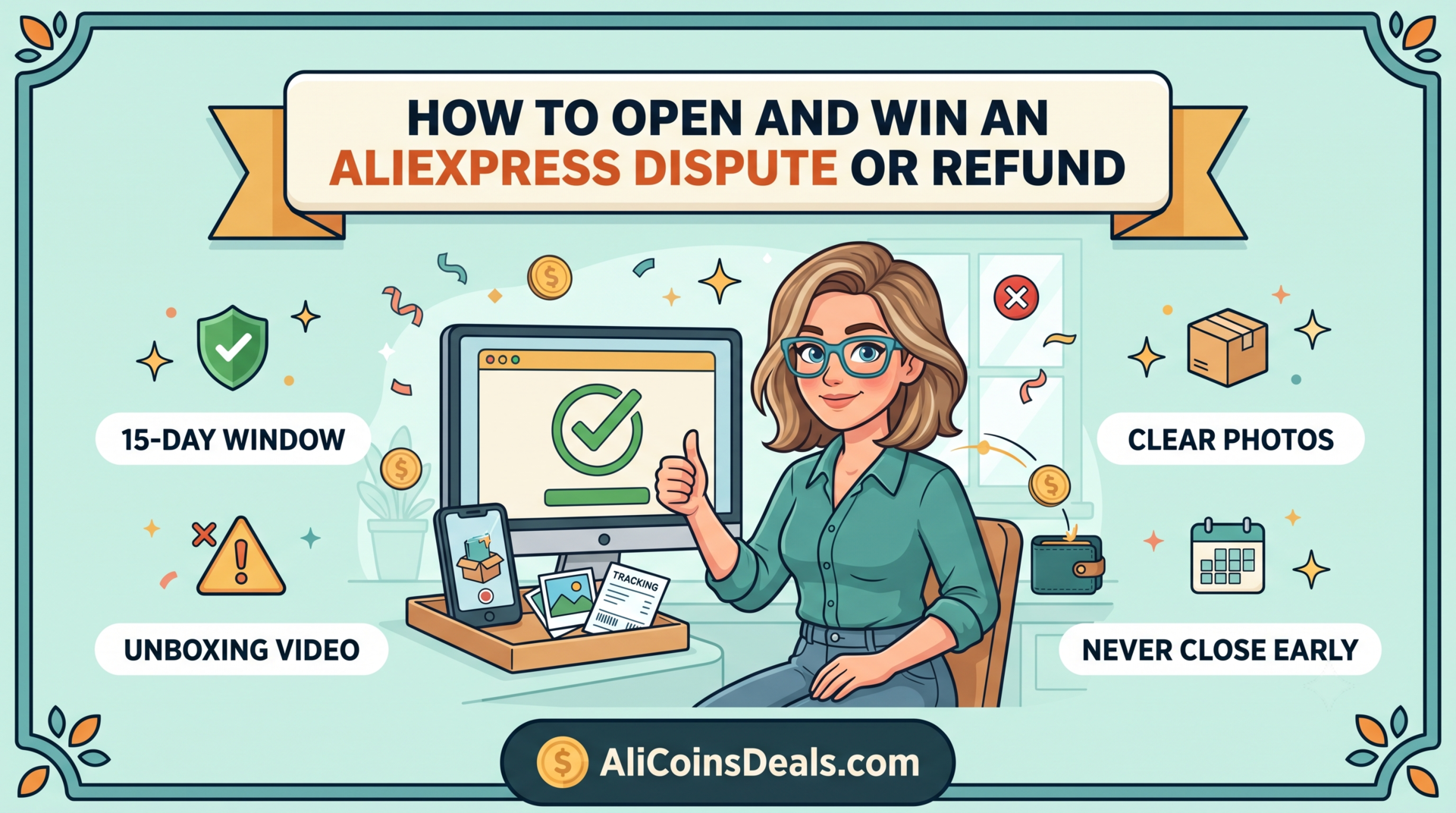
Disclosure: this article contains affiliate links. If you buy through them, AliCoinsDeals may earn a commission at no extra cost to you.
You win an AliExpress dispute by filing inside the window, choosing the true reason, and attaching evidence the mediator can judge quickly. If AliExpress still rules against you, the decision is not the end. For EU, EEA and UK buyers it becomes final only after 20 days, and PayPal, your card issuer and your statutory rights each run on their own clocks.
Those outside deadlines are where most buyers lose money, because nobody tells them the clocks are already running. This guide covers the dispute itself, then the escalation routes, with each deadline taken from the rules that set it. The policy background lives in our Buyer Protection guide.
Key Takeaways
- A not-as-described or damaged claim must be raised within 15 days of receiving the item. Non-delivery claims run to the guaranteed window on your order.
- For EU, EEA and UK buyers, AliExpress’s decision becomes final after 20 calendar days unless you apply for arbitration.
- PayPal gives 30 days from delivery for a not-as-described dispute in the US, so a long AliExpress dispute can use it up.
- UK card chargebacks usually allow around 120 days. Section 75 only covers single items priced over £100.
- EU buyers keep a 2-year legal guarantee from delivery, and AliExpress’s own terms say its rulings don’t remove it.
When Can You Open an AliExpress Dispute?
It depends on what went wrong. AliExpress’s Buyer Protection page covers an order that “doesn’t match the item descriptions or photos or arrived damaged/shortage, within 15days from receiving the item (s)”. For a parcel that never arrives, the claim runs to “the guaranteed delivery window in order detailed page”.
So the rule of thumb is simple. For a wrong or damaged item, inspect it the day it arrives and file at once. For a missing parcel, wait until the delivery window shown on your order has passed, then file with your tracking ready. The package never arrived guide covers that case in detail.
Don’t tap Confirm Receipt until you’ve checked the item. It tells AliExpress the order is done, and on Free Return items from EU sellers the 15-day return clock starts from that confirmation. If the system confirms receipt automatically after delivery, the clock starts then instead. Either way, the order screen shows the deadline that applies to you.
How Do You Open a Dispute, Step by Step?
The flow is the same in the app and on the website, and it starts from the order itself.
- Open the order. Go to My Orders, open the order, and choose Open Dispute or Returns & refunds.
- Choose refund only or return and refund. Refund only suits a lost parcel or a cheap item not worth posting back. Return and refund suits higher-value goods.
- Pick the true reason. The reason also decides who pays return postage, as explained in which dispute reason to choose.
- Write two or three factual sentences. What you ordered, what arrived, and what you want.
- Attach the evidence before you submit. A claim with nothing attached gives the mediator nothing to rule on.
Then watch the order screen. The seller replies inside the dispute, and you keep replying inside it too. Agreements made in chat or off the platform don’t count.
What Evidence Wins an AliExpress Dispute?
AliExpress’s EU, EEA and UK terms say that when it decides a dispute, it has “the right to rely on our records and request either or both of you and seller to provide supporting documents”. It does not publish how it weighs them. In practice, these carry the most weight because they’re hard to argue with:
- One continuous unboxing video, from the sealed parcel with its label visible through to the fault, with no cuts.
- Clear daylight photos of the defect, the whole item, and the shipping label in one frame.
- Listing versus reality: a screenshot of the seller’s claim next to a photo of what arrived.
- For non-delivery, the tracking page showing no delivery scan, and any carrier reply confirming no proof of delivery.
Put the strongest item first and keep the files small enough to open quickly on a phone. If the seller sends a lower offer, you can reject it and hold your position, as long as you keep responding inside the deadlines shown on the order.
What Happens When AliExpress Rules Against You?
For EU, EEA and UK buyers, the answer is in AliExpress’s Terms and Conditions for Platform Transactions, updated 30 June 2026. Its dispute decision is not a court ruling. The terms state that Alibaba Singapore, the AliExpress entity that decides these disputes, “is not a judicial or arbitration institution”.
If you disagree, you can apply to the Hong Kong International Arbitration Centre “within 20 calendar days after the date of receipt of our determination”. Miss that and “you will be deemed to have agreed that our determination is final and binding on You.”
Arbitration in Hong Kong is rarely worth it for a small order. The more useful line comes next. The terms say this “does not deprive You of the protection afforded by mandatory provisions in the laws of the EU and the country of your habitual residence”. Your statutory consumer rights survive an AliExpress ruling. For most buyers, the real escalation is a payment dispute or those statutory rights.
Which Outside Deadlines Still Apply?
Each route has its own clock, and most start before AliExpress has even ruled. That is the trap. A buyer who waits for the mediator’s decision before looking elsewhere can find that the PayPal window closed a week earlier. Write down the dates on the day the problem starts. This table lists each route, checked against the rule that sets it.
| Route | Deadline | Source |
|---|---|---|
| AliExpress arbitration (EU/UK) | 20 calendar days from AliExpress’s decision | AliExpress EU/EEA/UK terms |
| PayPal, item not received | 180 days from payment | PayPal (US) |
| PayPal, not as described | 30 days from delivery, or 180 days from payment if sooner | PayPal (US) |
| PayPal dispute to claim | Escalate within 20 days or the dispute closes | PayPal (US) |
| UK card chargeback | Usually around 120 days | Financial Ombudsman Service |
| UK Section 75 | Single items priced over £100 and up to £30,000, credit card only | Consumer Credit Act 1974 |
| EU legal guarantee | At least 2 years from receiving the goods | European Commission, Your Europe |
The PayPal figures come from its dispute filing timeframes and escalation rules for US accounts. Check your own country’s PayPal pages, since terms vary by region. The UK and EU rows apply only where you live there and paid with a card issued there, so treat them as the routes to ask about, not a guarantee of a refund.
Which Escalation Route Fits Your Case?
If you paid with PayPal, watch the 30-day not-as-described clock from the day you start. It runs from delivery, not from AliExpress’s ruling. PayPal also states that a dispute “will automatically close after 20 days unless it’s been escalated” and that “closed disputes cannot be reopened”.
If you paid by card in the UK, ask your bank about a chargeback. The Financial Ombudsman Service says you “usually have around 120 days”, and that a bank “doesn’t have to raise a chargeback” but should where valid reasons exist. Section 75 excludes items priced at £100 or less, so it rarely fits AliExpress orders.
If you’re in the EU, your 2-year legal guarantee runs “from the moment you received the goods”. One thing has changed: the EU’s online dispute platform was discontinued on 20 July 2025. Use your national consumer dispute body instead.
A chargeback can affect your relationship with the platform, so keep it for real losses after the internal process has failed.
What Mistakes Lose a Winnable Dispute?
Most lost disputes are lost on procedure, not on the facts. These four come up again and again.
- Waiting for AliExpress before acting elsewhere. The PayPal and card clocks run from payment or delivery. By the time a long dispute ends, a 30-day window can be gone. Note every deadline the day the problem starts.
- Closing the dispute on a promise. A seller who offers a refund “if you close the case” can refund you inside the dispute instead. Keep it open until the money shows on the order.
- Choosing a reason that isn’t true. A seller may suggest a cancel or dispute reason that puts the fault on you. Pick the reason that matches what happened, because it also decides who pays return postage.
- Ignoring the 20-day arbitration window. You may never use arbitration, but the date matters. After it, AliExpress treats its decision as final and binding, so make your decision before it passes.
If you’re stuck in automated replies, how to contact AliExpress support lists the routes that reach a person.
Frequently Asked Questions
How long do I have to open an AliExpress dispute?
For an item that doesn’t match the listing or arrived damaged, AliExpress’s Buyer Protection page says within 15 days of receiving it. For a parcel that never arrives, the claim runs to the guaranteed delivery window shown on your order page. Check the deadline on the order screen itself.
What can I do if AliExpress rejects my dispute?
In the EU, EEA and UK, you have 20 calendar days to apply for arbitration before the decision becomes final. More practically, you can open a PayPal dispute or a card chargeback if their deadlines haven’t passed, and EU buyers keep their 2-year legal guarantee.
Is AliExpress’s dispute decision final?
Not straight away for EU, EEA and UK buyers. AliExpress’s terms make its decision final only if you don’t apply for arbitration within 20 calendar days. Even then, the terms say your mandatory consumer rights under EU, UK and national law are not removed by the decision.
Can I open a PayPal dispute for an AliExpress order?
Yes, if you paid with PayPal. For US accounts, PayPal allows 180 days from payment for an item not received, and 30 days from delivery for a significantly not-as-described item. Escalate the dispute to a claim within 20 days, or PayPal closes it automatically.
Does Section 75 cover AliExpress purchases?
Rarely. Section 75 of the Consumer Credit Act only applies to single items priced over £100 and up to £30,000, bought on a UK credit card. Most AliExpress items cost less. For cheaper items, ask your card issuer about a chargeback, usually within about 120 days.
An AliExpress dispute is won on timing and evidence, and a lost one is often recoverable for the same reason. File inside the window, attach proof the mediator can judge at a glance, and write down every outside deadline the day the problem starts. That way a rejection is the start of your next step, not the end of your money.
Ready to unlock massive savings?
Don't pay full price on AliExpress. Use our free coin converter to find hidden discounts up to 90% off.