Disclosure: this article contains affiliate links. If you buy through them, AliCoinsDeals may earn a commission at no extra cost to you.
If you shop from AliExpress inside the European Union, the rules just changed in a big way. On 1 July 2026 the EU removed its long-standing €150 customs-duty exemption and switched on a new charge, so the “under €150 means no duty” habit is now out of date.
The headlines have been noisy and often wrong, mixing up two very different fees. This guide sorts out what actually took effect, who pays it, and which parts are still only proposals, so you can budget for a European order without guessing.
Key Takeaways
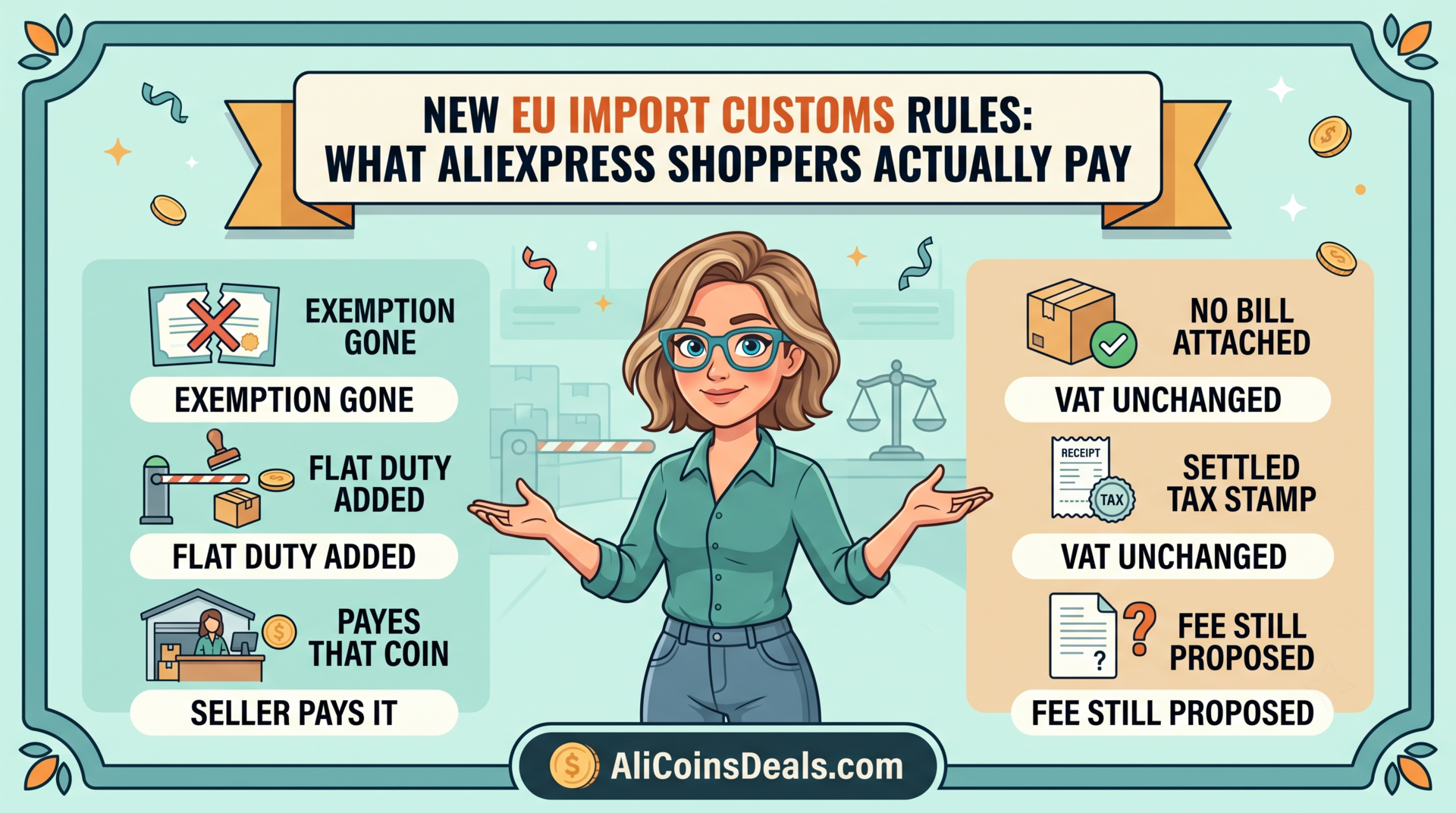
- Since 1 July 2026, the EU’s €150 customs-duty exemption is gone, and a temporary €3 flat duty per item applies to goods valued up to €150 (European Commission, 2026).
- The €3 is a customs duty, paid by the seller or importer, not a doorstep bill for you. It runs until 1 July 2028.
- A separate €2 handling fee per parcel is still only a proposal, with its amount and start date due to be decided in autumn 2026.
- VAT has applied to all EU imports since July 2021, so this reform is about duty, not a brand-new tax on the goods themselves.
What Changed for EU Imports in July 2026?
The EU abolished the €150 customs-duty exemption and replaced it with a temporary €3 flat duty per item on consignments valued up to €150, effective 1 July 2026 (European Commission, 2026). The old rule let low-value parcels enter duty-free. That door is now closed.
Two details matter. First, this is a customs duty, a tariff on bringing the goods in, not the same thing as VAT. Second, it is charged per item, not per parcel, so an order with several separate goods can attract the duty more than once. The measure is explicitly temporary and is set to run until 1 July 2028, when the wider customs overhaul takes over.
Why Did the EU Scrap the €150 Exemption?
The volume of tiny parcels simply exploded. In 2024, about 4.6 billion low-value consignments worth €150 or less entered the EU, roughly 12 million a day, up from 2.3 billion in 2023 and 1.4 billion in 2022 (European Parliament, 2025). Customs could not realistically check that flood.
Around 91% of those sub-€150 shipments came from China in 2024, driven by platforms like AliExpress, Temu, and Shein (European Parliament, 2025). Lawmakers argued the exemption gave overseas sellers an edge over EU retailers and left gaps for unsafe or undervalued goods. In November 2025, member states agreed to act faster than first planned, pulling the change forward from 2028 to 2026 (European Commission, 2025).
Our take: the parcel count roughly doubled every year from 2022 to 2024. A rule written for a trickle of postcards was never going to survive billions of shipments, so this reform was a question of when, not if.
Who Actually Pays the New €3 Customs Duty?
The seller or importer pays, not you at the door. Under the rules published in June 2026, the duty falls on the declarant of the goods, meaning the seller, the IOSS holder, or their representative, rather than the consumer receiving the parcel (European Commission, 2026). The legal basis is Council Regulation (EU) 2026/382.
In practice, though, businesses rarely absorb costs forever. Expect some of the €3 to surface as slightly higher listed prices or thinner discounts over time, especially on very cheap items where €3 is a large slice of the total. From 1 November 2026, sellers must also attach mandatory Product Identifiers to shipments, which is the plumbing that lets customs apply the duty automatically. So while it is not a doorstep charge, it is not free money either.
What Is the €2 Handling Fee, and Is It Real Yet?
It is a separate proposal, and it is not law yet. Do not confuse it with the €3 duty. The European Commission’s February 2025 e-commerce plan floated a €2 handling fee per parcel sent directly to consumers, with a reduced fee of around €0.50 for goods routed through an EU warehouse first (European Parliament, 2025).
Parliament’s position is that platforms, not shoppers, should foot this fee. Crucially, the amount and start date are still to be decided in autumn 2026, and reporting on the timing conflicts. So treat any headline that states a firm €2 charge on your orders today as premature. The duty is here; the handling fee is still being argued over.
Here is how the two charges line up:
| Charge | Status (July 2026) | Amount | Basis | Who pays |
|---|---|---|---|---|
| Customs duty | In force since 1 Jul 2026 | €3 per item (≤€150) | Reg (EU) 2026/382 | Seller / importer |
| Handling fee | Proposed only | Feb 2025 proposal | Platform (proposed) |
Does This Add a New Tax on Top of VAT?
No, this reform is about duty, not VAT. Import VAT has already applied to all goods entering the EU since 1 July 2021, when the old €22 low-value exemption was scrapped (European Commission, 2021). So VAT on your AliExpress order is nothing new. What changed in 2026 is the separate customs-duty layer.
For most orders up to €150, VAT is still collected at checkout through the Import One-Stop Shop (IOSS), which is why your AliExpress total often already includes it and the parcel clears smoothly. The €3 duty sits alongside that system rather than replacing it. If you want the full picture of how VAT, duty, and thresholds interact across countries, our import tax and customs fees by country guide breaks down each mechanism.
What Is Coming After 2028?
A much bigger overhaul is already agreed in principle. On 26 March 2026, the Council and Parliament reached a provisional deal on what the EU calls its most ambitious customs reform since 1968 (European Commission, 2026). It permanently abolishes the €150 threshold and builds new machinery to handle the parcel flood.
Two pieces stand out for shoppers. A new EU Customs Authority, to be based in Lille with around 250 staff, will oversee an EU Customs Data Hub that goes live for e-commerce on 1 July 2028. And a “deemed importer” rule will make online platforms the official importer, responsible for collecting duties and VAT at the point of sale. In theory, that means fewer surprise bills on delivery, because the charges are handled up front by the platform rather than sprung on you by a courier.
How to Avoid Surprises When Buying from AliExpress in the EU
You cannot dodge a legitimate duty, but you can stop it from ambushing your budget. The €3 is charged per item, so the way you build a basket now matters more than it used to. A few habits keep the final price honest.
- Read the checkout total line by line. A visible VAT or fee line means it is handled up front; the price you confirm is the price you pay.
- Expect the duty to appear at the final payment step. The duty is added late in the flow, so the total you approve can be higher than the total you shopped against. Screenshot the breakdown before you pay, and look for the explicit statement that no further duties will be collected on delivery. If that statement is missing, a courier may still bill you, and claiming a wrongly collected duty back needs that screenshot.
- Prefer Choice and IOSS-registered listings. Sellers that prepay charges at checkout give you a cleaner clearance and fewer courier handling surprises.
- Do not assume European stock is charge-free. A local dispatch label is a shipping fact, not a customs status, and buyers report the duty line appearing anyway. What EU stock reliably buys you is speed and an affordable return, as covered in AliExpress EU warehouses.
- Watch multi-item orders. Because the €3 duty is per item, a basket of several cheap separate goods can rack up multiple duties. Bundling into fewer listings can help.
- Budget the duty into big sale hauls. Plan around events with our 2026 sale calendar, and fold the likely charges into your target price rather than the sticker.
Remember that Buyer Protection covers problems with the order itself, never customs duties or VAT. Those are set by governments, so the platform cannot refund them. You can still stretch your budget with coins and promo codes, and the coin discount tool on our homepage helps you confirm the real price after savings.
Frequently Asked Questions
Do I now pay a €3 fee on every AliExpress order to the EU?
The €3 is a customs duty on goods valued up to €150, live since 1 July 2026, and it is charged per item rather than per order (European Commission, 2026). Officially the seller or importer pays it, though some cost may show up in prices over time.
Is the €3 duty the same as the €2 handling fee?
No. The €3 is a customs duty that took effect on 1 July 2026 and is in force now. The €2 handling fee is a separate proposal from the Commission’s 2025 plan, with its amount and start date not due to be settled until autumn 2026 (European Parliament, 2025). Do not confuse the two.
Why did the EU remove the €150 customs exemption?
Because low-value parcels surged to about 4.6 billion in 2024, with roughly 91% coming from China (European Parliament, 2025). Lawmakers said the exemption disadvantaged EU retailers and let unsafe or undervalued goods slip through, so member states brought the change forward to 2026.
Will my AliExpress prices go up because of this?
Possibly, but not automatically. The duty is legally the seller’s to pay, so it will not appear as a delivery bill. Over time, businesses may pass some of the €3 into listed prices or trim discounts, especially on very cheap items where €3 is a big share of the cost. Watch your checkout totals.
Does this change replace VAT on AliExpress orders?
No. Import VAT has applied to all EU imports since July 2021 and is unchanged (European Commission, 2021). For orders up to €150 it is still typically collected at checkout via IOSS. The 2026 reform adds a customs-duty layer on top; it does not touch how VAT works.
Customs rules only feel unfair when they arrive unannounced. The picture for 2026 is actually simpler than the headlines suggest: a €3 customs duty per item is in force, your seller is on the hook for it, VAT works exactly as before, and the much-discussed €2 handling fee is still just a proposal. Keep an eye on your checkout totals, lean toward listings that prepay charges, and verify anything time-sensitive with the European Commission’s customs pages, because this reform is still rolling out.
This article is general information, not tax or legal advice. Rules and dates can change; confirm current details with the European Commission or your national customs authority before relying on them.
Ready to unlock massive savings?
Don't pay full price on AliExpress. Use our free coin converter to find hidden discounts up to 90% off.