Which AliExpress Dispute Reason Should You Choose?
Written by
Disclosure: this article contains affiliate links. If you buy through them, AliCoinsDeals may earn a commission at no extra cost to you.
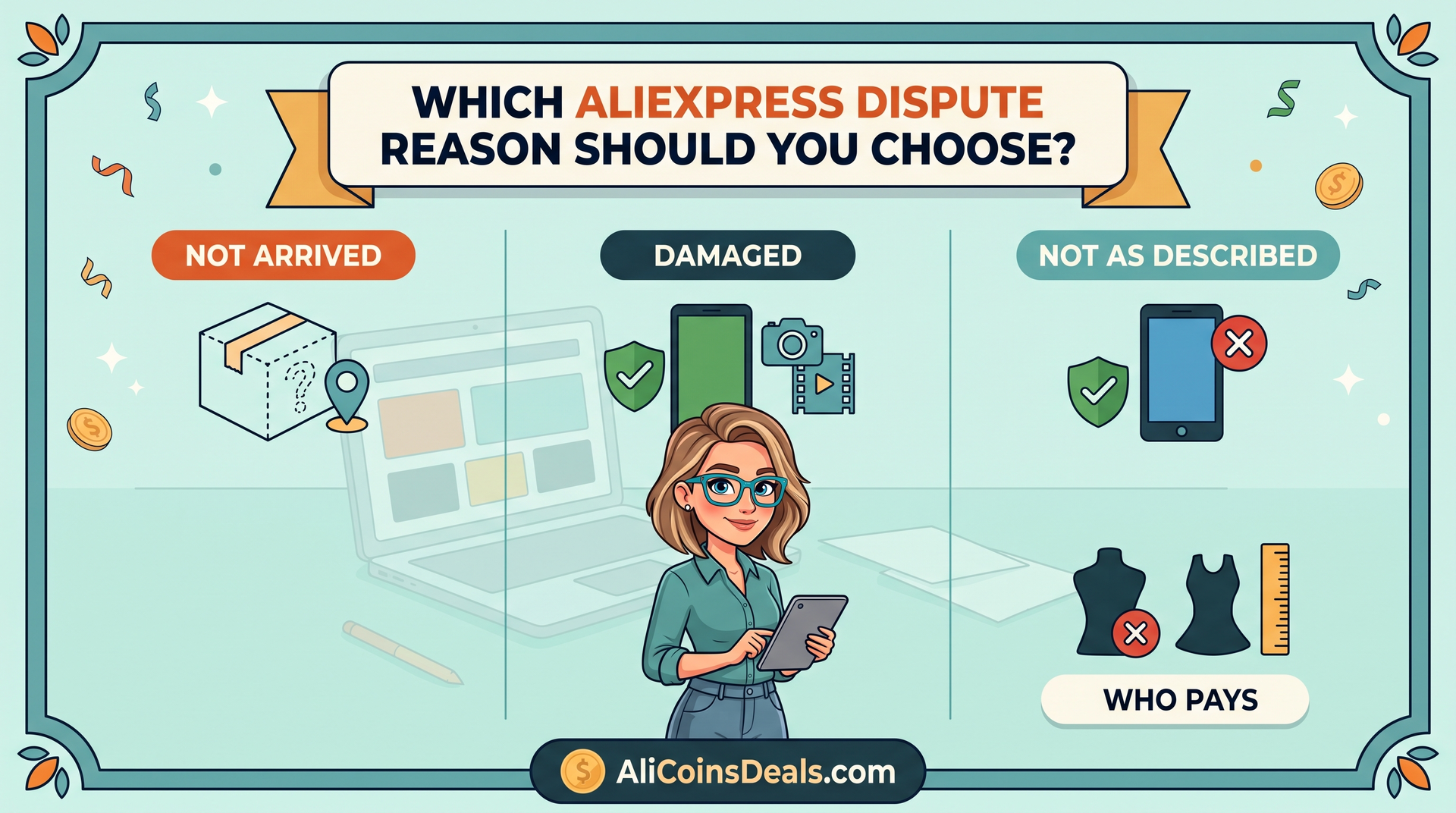
The reason you select when opening an AliExpress dispute is a routing decision, not a description. It sets whether a return is required, who pays the postage, and what you have to prove. Two buyers with the same broken item can end up with very different outcomes purely because of that dropdown.
Most guides tell you to gather evidence and hold firm. Fewer tell you that the evidence which wins depends entirely on the lane you chose at the start. Pick the reason that accurately matches the primary fault, and the rest of the process gets much easier.
Key Takeaways
- The reason field determines the claim type. Everything downstream, including return shipping, follows from it.
- Defect and damage claims are the cheapest to run, because the fault is physical and demonstrable on video.
- Authenticity and description claims often require you to ship the item back at your own cost, which can exceed the refund.
- Pick the reason that is actually true. A mismatched reason gets rejected on the evidence, and a rejection is harder to recover from than a slow claim.
- You generally get one clean shot per order, so decide before you open the dispute, not during it.
Why Does the Dispute Reason Matter More Than the Description?
Because the reason decides which test your evidence is measured against. A damage claim is judged on whether the item is broken. A “not as described” claim is judged on whether the item differs from the listing, which means the listing text and photos are now part of the case, and sellers write listings carefully.
The free-text description you add is read second, and only in the context of the reason. If you select an authenticity claim and then describe a cracked casing, the two do not line up, and a claim that does not line up is the easiest kind to reject.
So the ordering matters. Work out what is actually wrong with the item first, decide which single fault is the strongest and most provable, then select the reason that matches it and write a description that supports exactly that. The full evidence checklist is in how to open and win an AliExpress dispute.
Which Reasons Usually Require You to Return the Item?
Broadly, the claims that turn on what the item is, rather than whether it works. If your case is that the goods are fake, or different from the listing, the platform’s instinct is to want the goods back, and it commonly asks you to ship them at your own expense.
Claims that turn on the item never arriving require no return, because there is nothing to send. Claims that turn on a physical defect frequently resolve without a return, or with a prepaid label, because photographs and video settle it and the seller has little interest in paying freight for a broken unit.
That produces a rough cost hierarchy, worth knowing before you choose:
| Claim type | Return usually needed | What decides it | Practical cost to you |
|---|---|---|---|
| Item never arrived | No | Tracking and the delivery window | None |
| Arrived damaged or faulty | Sometimes | Photos and unedited video of the fault | Low, label often paid |
| Missing item or missing parts | Rarely | Packaging photos and the parcel weight | Low |
| Not as described | Often | The listing text and photos versus the item | Postage to China |
| Counterfeit or authenticity | Usually | Brand evidence, and the goods themselves | Postage to China |
What Does Each Reason Ask You to Prove?
A non-delivery claim asks for tracking that shows no delivery inside the guaranteed window. That is the easiest claim on the platform, and it is covered in AliExpress package never arrived.
A damage or fault claim asks for visual proof. One continuous unedited video from sealed parcel to failed item is worth more than a dozen photos, because it removes the argument that the damage happened later. Film the label, the packaging, the unboxing and the fault in a single take.
A “not as described” claim asks you to line the listing up against the item, side by side, on the specific attribute that differs. Vague dissatisfaction fails here. A measured dimension, a stated capacity, a named material or a specified model number succeeds, because it is a factual mismatch rather than an opinion.
An authenticity claim asks for the most work: evidence the item is not what it claims to be, which usually means brand markings, serials, or a comparison against the genuine article. This is also the lane most likely to end with you paying freight.
What Happens If You Pick the Wrong Reason?
The claim is assessed against a test your evidence was never built for, and it fails on that basis. A genuine complaint can be rejected simply because it was filed in the wrong lane, and the rejection is recorded against the order.
Recovering from that is harder than getting it right first time. You can sometimes escalate or appeal, but you are now arguing about the process as well as the item, and your protection window keeps running while you do. If the window closes mid-argument, the claim ends.
There is also a quieter cost. Buyers who file an authenticity claim about an item that simply broke often get offered a small partial refund, accept it out of fatigue, and never learn that a defect claim on the same item would have been resolved without a return at all.
Should You Change or Reopen a Dispute After Filing?
Treat the first filing as the real one. Depending on the stage of the order, the platform may let you edit details or add evidence, but the claim type is not something to experiment with, and repeatedly reframing the same complaint reads badly.
If new information genuinely appears, for example the item arrives after you filed for non-delivery, add it to the open dispute rather than opening a second one. Escalate inside the existing case if the seller stalls.
The one thing never worth doing is closing a dispute on a verbal promise so you can file a different one. Closing it can end your claim on that order for good, and the promised refund has no mechanism behind it once the case is shut.
When Is a Counterfeit Claim Still the Right Call?
When the item genuinely is a counterfeit and you want that recorded, and when the money is large enough to justify the return postage. A branded item at a fraction of retail that arrives with fake markings is exactly what the counterfeit route exists for.
Be clear-eyed about the trade-off. You may be asked to return it at your own cost, and on a low-value item that is not worth doing. On a high-value item it very much is, and the brand evidence you attach is the strongest kind of proof on the platform.
The better move is earlier: avoid the claim entirely by vetting the listing before you pay. The five-minute version of that is in vet an AliExpress seller in 60 seconds, and the return-cost mechanics are in AliExpress free returns.
Frequently Asked Questions
Does AliExpress really treat dispute reasons differently?
Yes. Each reason is a distinct claim type with its own evidence test and its own handling of returns. That is why an identical complaint can resolve without a return under one reason and require postage to China under another. Choose based on what is actually wrong with the item.
What is the strongest evidence in any AliExpress dispute?
One continuous, unedited video that starts with the sealed parcel and the shipping label and ends with the fault on camera. It defeats the two most common seller arguments at once, that the wrong parcel is being shown and that the damage happened after delivery.
Can I claim a refund without returning a faulty item?
Often, yes, if the fault is clear on video and the item has little resale value to the seller. Ask explicitly for a refund without return and support it with the footage. The eligibility rules are set out in AliExpress refunds without returning the item.
Should I pick “not as described” if I am just disappointed?
No. Disappointment is not a mismatch. That reason needs a specific factual difference between the listing and the item, such as a wrong measurement, capacity, material or model. Without one, the claim usually fails and you may have paid postage to reach that outcome.
How long do I have to open a dispute?
Inside your order’s Buyer Protection window, which commonly runs to around 90 days from purchase, and never after confirming receipt. Confirming receipt can end your claim immediately. The deadlines are laid out in AliExpress Buyer Protection.
Disputes on AliExpress are not decided by how firmly you argue. They are decided by whether your evidence matches the test attached to the reason you selected. Work out the single strongest, most provable fault with your item, file under the reason that describes it truthfully, and film the proof before you touch the dropdown. That order of operations is worth more than any wording trick.
Ready to unlock massive savings?
Don't pay full price on AliExpress. Use our free coin converter to find hidden discounts up to 90% off.