AliExpress Free Returns: Who Pays Return Shipping?
Written by
Disclosure: this article contains affiliate links. If you buy through them, AliCoinsDeals may earn a commission at no extra cost to you.
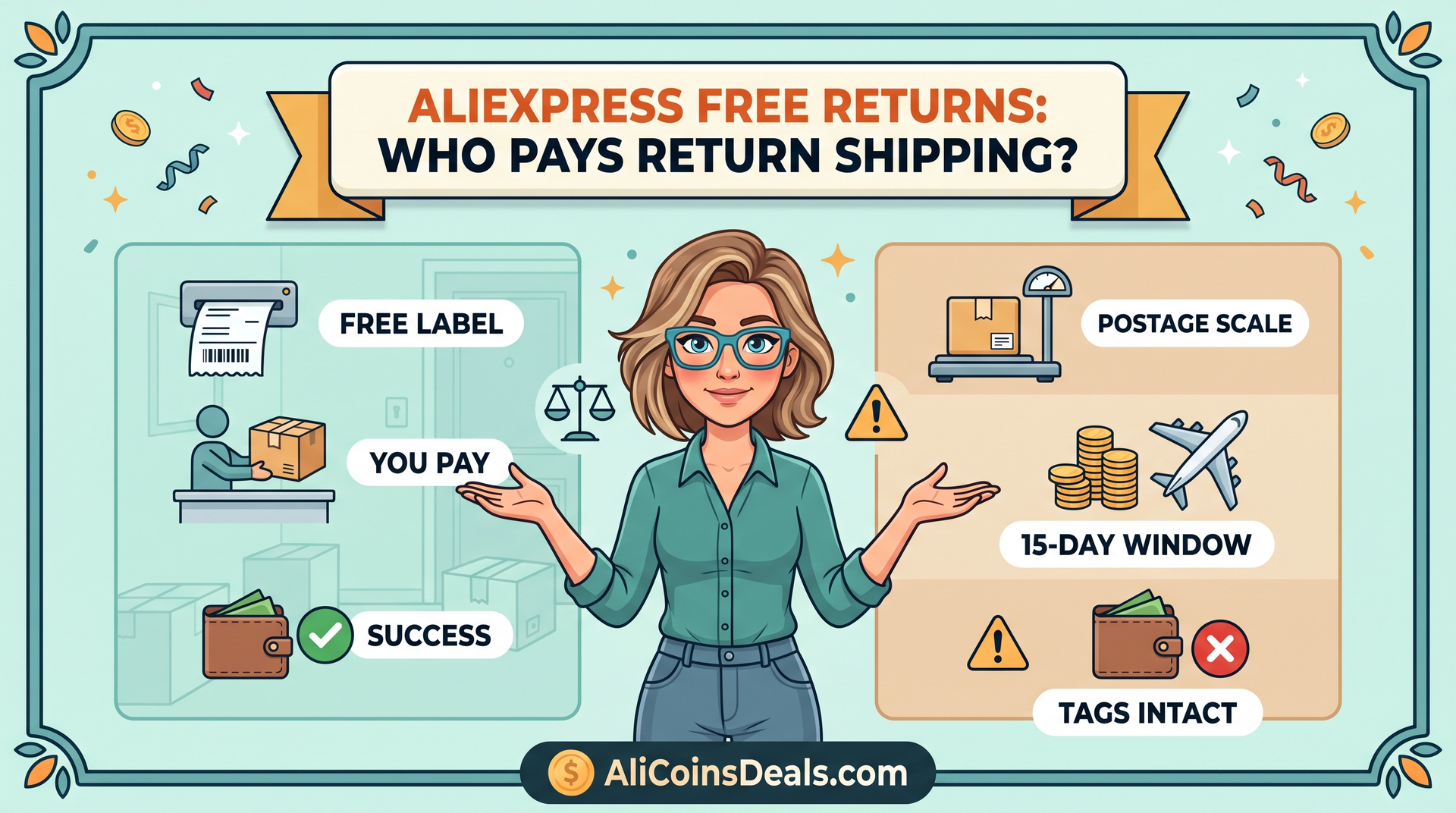
“Free returns” on AliExpress is a badge on individual listings, not a platform-wide right. When it applies and the item qualifies, you get a prepaid label and pay nothing. When it doesn’t, you pay international postage back to China yourself, and that bill frequently exceeds what the item cost.
That gap is where most returns go wrong. The badge you saw on the product page is not the same thing as the return options you see after the parcel arrives, and the dispute reason you pick can move the shipping cost from the seller to you. Here is how the money actually splits.
Key Takeaways
- “Free returns” is set per listing and per category, and runs 15 calendar days from delivery with 13 excluded categories (AliExpress terms).
- Without a free-return label, you pay the return postage up front and only get it back if the dispute outcome says so.
- The reason you select when opening a dispute decides who pays. A defect claim usually gets a paid label; a “not as described” claim often does not.
- Return postage to China on a heavy or bulky item can exceed the item’s price. When it does, a partial refund with no return is the better outcome.
- On a return, declare the real price paid and label the parcel as returned goods, so it is not treated as a fresh commercial import.
What Does the “Free Returns” Badge Actually Cover?
It covers the cost of shipping the item back, using a label AliExpress generates, for a limited window after delivery and only for eligible categories. The badge sits on the listing and in the order details. If it is not there, the listing was never in the programme, whatever the seller says in chat.
Three limits matter more than the badge itself, and they are set out in the platform’s own terms (AliExpress). The window is 15 calendar days from delivery, not from the order date. Thirteen product categories are excluded outright, as are oversized parcels. And the item must come back unused, with its tags, seals and original packaging intact.
A seller telling you in live chat that returns are free is not the same as the badge appearing on your order. Screenshot the listing before you buy. That screenshot is the evidence that matters if the return option later fails to appear.
Who Pays Return Shipping When There Is No Free Label?
You do, up front. AliExpress asks you to ship the item to a return address, usually in mainland China, at your own cost, and to upload the tracking number. If the dispute resolves in your favour on the right grounds, the postage may be reimbursed. If it resolves as a partial refund, it usually is not.
This is the single most expensive misunderstanding on the platform. A tracked parcel from the EU or the US to China commonly costs more than a mid-priced AliExpress order, and untracked postage is useless because you cannot prove delivery. No proof of delivery means no refund, so the cheap option is not an option.
Before you agree to any return, price the postage first. Get a real quote from your postal operator for the actual weight and dimensions. Then compare it to the refund on offer. If the postage is a large fraction of the refund, argue for a refund without a return instead, which is covered in AliExpress refunds without returning the item.
Does the Dispute Reason Change Who Pays?
Yes, and this is the mechanic almost nobody explains. The reason you select when you open a dispute routes your case down different paths, and those paths carry different shipping-cost outcomes. Two claims about the same broken item can end very differently.
Claims framed around a faulty or damaged product tend to attract a paid return label or a refund with no return, because the fault is not in dispute. Claims framed around authenticity or description tend to require you to return the item at your own expense, because the platform treats them as a disagreement about the goods rather than a defect.
Our take: accuracy still comes first. Describe what is actually wrong with the item, in plain terms, and choose the reason that matches. If the item genuinely arrived broken, unusable or malfunctioning, say exactly that, because a defect is both the truth and the claim the return system handles best.
The full evidence playbook lives in how to open and win an AliExpress dispute, and the reason-by-reason breakdown is in which AliExpress dispute reason to choose.
Why Do Returns Look Different Since July 2026?
Two things changed at once in the European Union, and buyers have been conflating them. The customs rules changed on 1 July 2026, when the EU removed its €150 duty exemption and switched on a flat duty per item (European Commission, 2026). Separately, EU buyers report that the multi-item free return flow they were used to has become harder to find on their orders.
Only the first of those is a documented rule change, and it is about importing, not returning. The practical effect is that a return now has a customs dimension it did not have before, and the free-return option is worth checking on every single listing rather than assuming it carries over from your last order.
If you shop from the EU, read the new EU import customs rules alongside this page. The duty and the return path interact, and the next section is where they meet.
What Value Do You Declare on a Customs Form for a Return?
Declare the actual price you paid, and mark the shipment as returned goods rather than a sale. Those two entries do different jobs: the value keeps the declaration truthful, and the returned-goods marking is what stops the parcel from being assessed as a fresh commercial import on arrival.
Write the item description plainly, attach the order number, and keep a copy of the label and the receipt. If your postal operator offers a returned-goods or “return to sender” option in its online form, use it. Retain the tracking until the refund lands, because the tracking is the only proof that you upheld your side.
Do not be tempted to declare a lower value to reduce charges. It is a false customs declaration, it can get the parcel held or destroyed, and a destroyed parcel means no delivery scan and no refund. The undervaluing risk falls entirely on you, not on the seller.
How Do You Get the Free Return Label, Step by Step?
- Open the order and check for the free-return option before doing anything else. Screenshot what you see.
- Message the seller and state the problem factually. Many sellers refund or resend rather than handle a return.
- Open a return or dispute from the order page and select the reason that truthfully matches the fault.
- If a prepaid label is offered, generate it, print it, and lodge the parcel at the designated drop-off point inside the stated window.
- Upload the tracking number to the dispute immediately. An unposted or untracked return is treated as no return at all.
- Keep the dispute open until the refund appears. Do not close it on a promise made in chat.
If the label never appears, escalate inside the dispute rather than paying for postage on your own initiative. Once you have shipped at your own cost, you have lost the leverage to argue about who should have paid.
Can You Use Your Own Consumer Law Instead?
Sometimes, and it is worth knowing the shape of it. In the United Kingdom, a customer who tells the trader within 14 days of receiving an item that they want to cancel is owed a refund, with a further 14 days to send the item back, and the refund due within 14 days of the trader receiving it (GOV.UK). Comparable distance-selling withdrawal rights apply across the EU.
The catch is enforcement. Those rules bind the trader, and on AliExpress the trader is usually a company in China, outside the reach of your national consumer body. In practice the platform’s own dispute system is the mechanism that actually moves money, which is why the reason you select there matters more than the law you can quote.
In the United States there is no federal right to return an unwanted item at all. Your leverage is Buyer Protection, and after that your card issuer. Both are covered in AliExpress Buyer Protection.
Frequently Asked Questions
Is every AliExpress return free?
No. Free returns are applied per listing and per category, and plenty of listings never carry the badge. Check the listing before buying and the order details before claiming. If the badge is absent, assume you will be asked to pay international postage back to China at your own cost.
What if returning the item costs more than the refund?
Say so in the dispute, with the postage quote attached. A return that costs more than the goods is a strong argument for a refund without a return, or for a partial refund you accept without shipping anything. Get the quote in writing from your postal operator first, because an unsupported claim carries little weight.
Does the seller have to send me a return label?
Not unless the listing carried free returns or the dispute outcome awards a paid return. Sellers frequently offer a partial refund instead, precisely because they know the postage maths. Weigh the partial refund against the real cost and hassle of shipping before rejecting it.
Can I get return shipping reimbursed afterwards?
Only if the dispute resolves on grounds that cover it, and only with proof. Upload the postage receipt and the tracking to the dispute while it is still open. Once a dispute is closed, reopening it to add a shipping cost you already paid is very difficult.
Do I pay customs duty again on a returned item?
You should not, provided the parcel is declared as returned goods rather than a new sale. Mark it clearly on the customs form, keep the original order paperwork, and expect to show it if asked. Any duty you already paid on the original import is a matter for your national customs authority, not for AliExpress.
Free returns on AliExpress are real, but they are a property of the listing rather than a promise of the platform. Check the badge before you buy, price the postage before you agree to any return, and describe the fault accurately when you open the dispute, because that description is what decides who covers the shipping. Where the postage rivals the refund, stop arguing about the return and argue for the money instead.
Ready to unlock massive savings?
Don't pay full price on AliExpress. Use our free coin converter to find hidden discounts up to 90% off.