Disclosure: this article contains affiliate links. If you buy through them, AliCoinsDeals may earn a commission at no extra cost to you.
A charger is the one cheap AliExpress buy that can genuinely hurt you. It plugs into the mains and sits charging unattended for hours, so a bad one isn’t just a waste of money, it’s a fire and shock risk.
The good news is that safe chargers are easy to find once you know what to check. This guide covers what lab tests have actually found, which certifications mean something, and how to spot a dangerous fake before you buy.
Key Takeaways
- In a June 2026 Which? lab test of cheap chargers sold via AliExpress, Amazon, Temu and others, 9 of 15 posed an electric-shock risk and 8 a fire risk. One fake was packed with modeling clay to fake its weight.
- A 2025 Electrical Safety First study found that 92% of counterfeit Apple 20W adapters failed a basic insulation safety test.
- A CE logo is self-declared, and an FCC mark only covers interference, not electrical safety. A genuine UL listing and the USB-IF database are marks you can actually verify.
- High-wattage USB-C cables, rated 100W and up, need a real e-marker chip. Cheap cables often fake or omit it.
Are AliExpress Chargers Safe to Buy?
It depends entirely on the seller, and the cheapest counterfeits are genuinely dangerous. Independent testing keeps finding that knock-off chargers fail basic safety checks at alarming rates, so the risk is real, not hypothetical. But branded, properly certified chargers sold on AliExpress can be perfectly safe.
The danger clusters around fakes that imitate big brands at a fraction of the price. A legitimate Anker or Ugreen charger is built to the standards it claims. A $6 “Apple” adapter almost certainly isn’t. The whole skill here is telling those two apart before you plug anything in.
What Have Lab Tests and Recalls Actually Found?
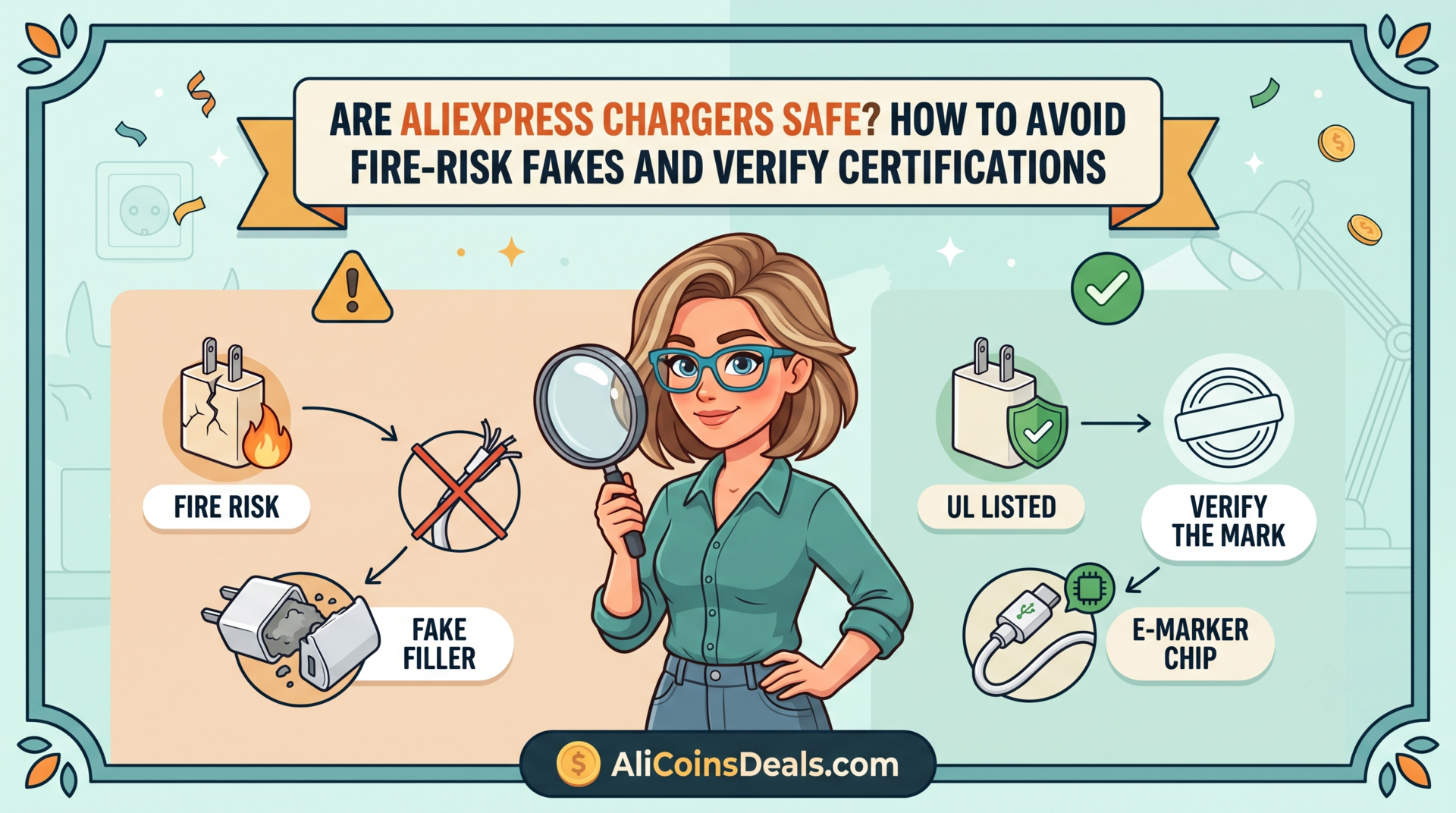
The evidence against cheap counterfeit chargers is damning. In June 2026, consumer group Which? lab-tested 15 cheap chargers from marketplaces including AliExpress, Amazon and Temu. Nine posed an electric-shock risk and eight a fire risk, and one fake Apple adapter arced within seconds and was found stuffed with modeling clay to mimic a real unit’s weight.
That isn’t a one-off. A 2025 Electrical Safety First study of 116 counterfeit Apple 20W adapters found 92% failed the insulation test, and many were weighted with hidden metal to feel genuine. Regulators act on this too: the US Consumer Product Safety Commission recalled HTRC battery chargers, sold via AliExpress and other sites, over fire and burn hazards. You can search current cases on the UK’s product safety recalls database.
Which Certifications Actually Matter?
Not all the logos on a charger mean what buyers think. A CE mark is a manufacturer’s self-declaration of conformity, not proof of independent testing, and counterfeiters print it freely. An FCC mark only covers electromagnetic interference, not electrical safety. So a charger can carry both and still be unsafe.
The marks worth trusting are the ones you can verify. A genuine UL listing reflects independent US safety testing, and USB-IF certification for cables and chargers can be checked against the official USB-IF product database. Watch for the “China Export” trap too: a near-identical logo with tighter letter spacing that only means “made in China,” not European conformity. If a logo can’t be verified anywhere, treat it as decoration.
What About USB-C Cables and Fast Charging?
Fast-charging cables have their own hidden catch: the e-marker chip. Any USB-C cable rated for 100W or 240W, or for USB4 and Thunderbolt speeds, must contain an e-marker that tells devices how much power and data it can safely handle. Cheap cables frequently omit it or program it falsely.
A cable that claims 240W without a real e-marker can let a device pull more current than the wire can handle, which means heat. So treat steep wattage claims on bargain cables with suspicion, and stick to cables whose specs you can confirm. The same USB-IF database that lists certified chargers covers cables, which beats trusting a printed number.
How Do You Spot a Fake or Unsafe Charger?
A few quick checks catch most dangerous chargers before they reach your wall socket. Genuine units are built with real components, so they have weight, stay cool, and carry verifiable markings. Fakes cut every one of those corners.
Run through this list before buying or plugging in:
- Weight. A real 65W GaN charger is fairly dense. A fake can be 30% to 50% lighter because it’s missing safety components.
- Price. A 65W GaN charger for under roughly $15 to $20 is almost certainly counterfeit.
- Branding. Anything mimicking Apple or Samsung at a tiny fraction of the price is the highest-risk category.
- Pins and build. Flimsy prongs and loose casing are red flags, since weak pins can lodge live in a socket.
- Labeling. Missing or implausible certification numbers, typos, or the “China Export” logo all signal trouble.
How to Buy a Charger Safely on AliExpress
Favor named brands that publish their real power ratings and certifications, such as Anker, Ugreen, Baseus or Belkin. These companies build to the standards they advertise, and their listings give you specifications you can actually verify rather than vague claims. Pay the few extra dollars; on a mains device it’s worth it.
Then apply the usual marketplace discipline: check the seller’s rating and reviews, look for buyer photos of the actual unit, and avoid any listing that imitates a premium brand at a suspicious price. Our guide to vetting an AliExpress seller in 60 seconds covers the trust signals, and if a charger arrives clearly fake or faulty, Buyer Protection lets you claim a refund.
Frequently Asked Questions
Are cheap chargers from AliExpress dangerous?
The counterfeit ones can be. A 2026 Which? lab test found most cheap no-brand chargers it sampled posed a shock or fire risk, and a 2025 study found 92% of fake Apple adapters failed insulation testing. Properly certified, branded chargers are a different story and are generally safe to buy.
How can I tell if an AliExpress charger is genuine?
Check weight, price, and verifiable certification. Real chargers feel dense, cost more than a few dollars, and carry markings you can confirm, such as a UL listing or USB-IF entry. Fakes are suspiciously light and cheap, often imitate a big brand, and rely on self-declared CE logos you can’t verify anywhere.
Does a CE mark mean an AliExpress charger is safe?
Not by itself. A CE mark is the manufacturer’s own declaration, not independent proof of testing, and counterfeiters add it freely. There’s also a lookalike “China Export” logo. Trust verifiable marks instead, like a genuine UL listing or a USB-IF database entry, rather than a printed CE symbol alone.
Are AliExpress USB-C fast-charging cables safe?
They can be, but high-wattage cables need a real e-marker chip to manage power safely, and cheap ones often fake or skip it. A cable claiming 100W or 240W without genuine certification can overheat. Buy cables whose specifications you can verify, ideally from a known brand, rather than trusting the printed wattage.
Which charger brands are safe to buy on AliExpress?
Stick to established brands that publish real certifications, such as Anker, Ugreen, Baseus and Belkin. They build to the standards they claim and list verifiable specifications. Avoid listings that imitate Apple or Samsung at a fraction of the price, since that’s where dangerous counterfeits concentrate.
Chargers aren’t the only category where a cheap buy carries real risk. The same caution applies to buying electronics generally, where specs are routinely overstated, and to cosmetics, where counterfeits have tested positive for heavy metals.
A charger is no place to chase the very lowest price. The lab tests are clear that cheap counterfeits fail basic safety checks, but a properly certified charger from a known brand is a safe, sensible buy. Check the weight, verify the certifications you can, lean on real brands, and a mains charger stays exactly as boring as it should be.
Ready to unlock massive savings?
Don't pay full price on AliExpress. Use our free coin converter to find hidden discounts up to 90% off.