Disclosure: this article contains affiliate links. If you buy through them, AliCoinsDeals may earn a commission at no extra cost to you.
Electronics are one of the most rewarding categories on the platform, and one of the easiest to get wrong if you rush. A little homework, plus the right promo codes, turns a gamble into a genuinely smart buy.
So is AliExpress good for electronics? For components, cables, accessories, modules, and budget gadgets, yes, it’s hard to beat. For expensive branded gear, you need to be far more careful. This guide covers what to buy with confidence, how to vet a seller and a listing, and how to read specs and reviews critically. It also covers spotting counterfeits, and the gotchas that catch people out: voltage, plugs, radio bands, warranty.
Key Takeaways
- AliExpress shines for components, cables, accessories, hobby and maker gear, and cheap gadgets. Treat expensive branded items with extra caution.
- The listing’s track record matters most: store rating, positive feedback percentage, store age, review volume, and reviews with real buyer photos.
- A “brand name” priced far below everywhere else is the classic counterfeit signal. Vague “OEM” or “compatible” wording and missing model numbers back it up.
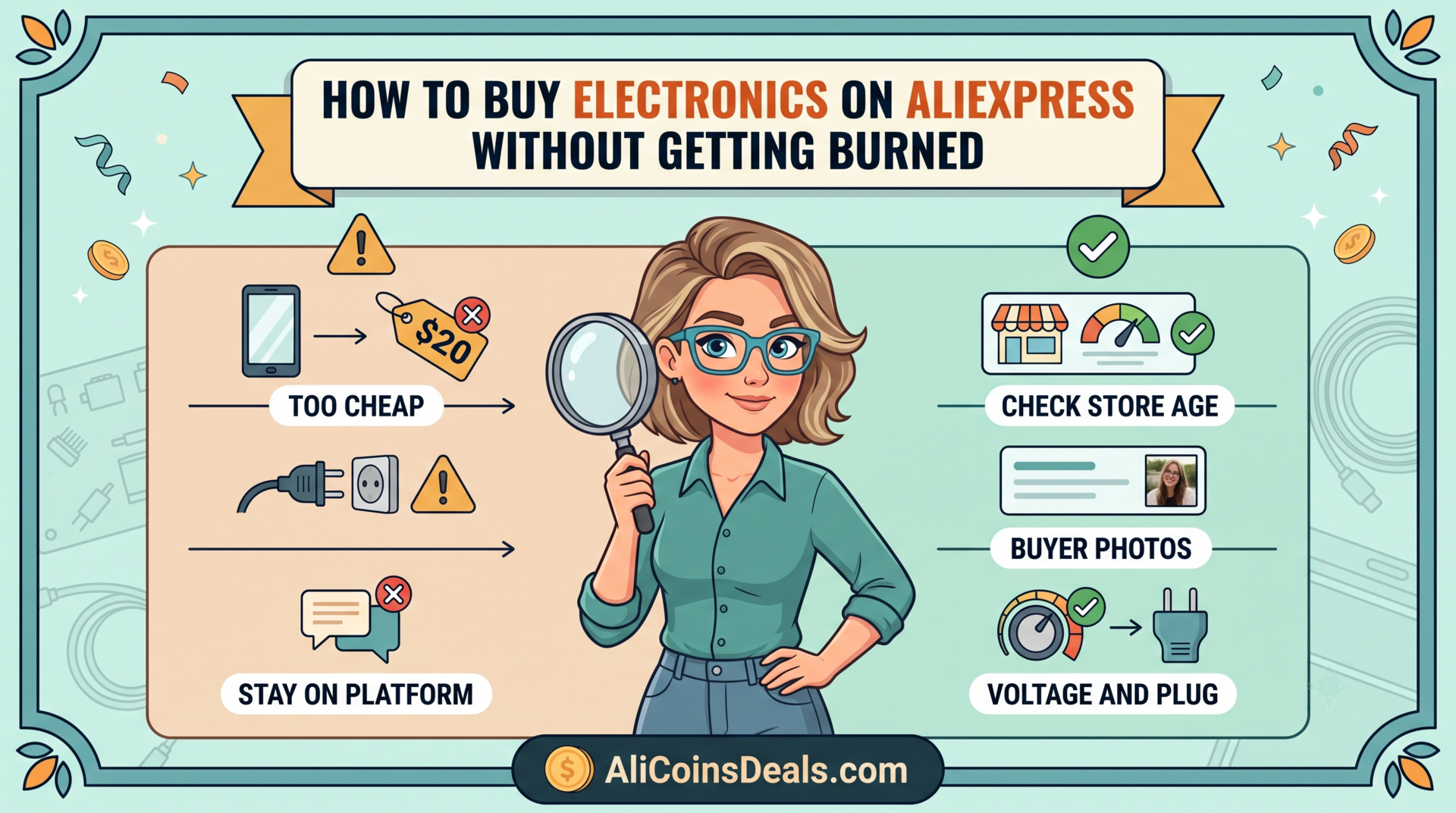
- Mind voltage (110V vs 220V), plug type, and radio frequency bands. Stay on-platform so Buyer Protection covers you.
Is AliExpress Good for Electronics?
For a huge slice of electronics, AliExpress is excellent value, but the answer depends entirely on what you’re buying. The platform connects you directly to factories and wholesalers in Shenzhen and across China’s electronics manufacturing belt, the same region that supplies many of the world’s best-known brands. That direct line is exactly why prices on the right items are so low.
Where it wins: passive and active components, breakout boards, microcontrollers, sensors, connectors, cables, chargers, phone and laptop accessories, soldering and repair tools, LED strips, and small budget gadgets. Hobbyists and makers, in particular, get fantastic mileage here. If a part costs a few dollars and ships from a high-volume store, the downside is small and the savings are real.
Where you slow down: premium branded phones, big-name headphones, graphics cards, and anything where a fake costs nearly as much to fake as the real thing. The closer an item sits to a famous brand, the harder you should vet it, and the more you should ask whether that price is even plausible.
What to Buy With Confidence vs What to Approach With Caution
Use the listing’s category and price as your first filter. The table below sorts common electronics buys into three tiers: “buy with confidence,” “do your homework,” and “be very cautious.” It ranks them by how often each category disappoints, and how hard a counterfeit is to pull off.
| Confidence level | Typical items | Why |
|---|---|---|
| Buy with confidence | Cables, chargers, adapters, components, modules, sensors, repair tools | Cheap, generic, high review volume, low stakes if one is a dud |
| Do your homework | Earbuds, smartwatches, power banks, dash cams, small appliances, LED lighting | Quality varies wildly by store; specs are often exaggerated |
| Be very cautious | “Brand name” phones, premium headphones, GPUs, memory cards, name-brand batteries | Prime counterfeit targets; a clone can look identical in photos |
None of this means the cautious row is off-limits. It means you read every review, confirm the model number, and accept that a deal far below market rate is usually too good to be true.
How Do You Vet the Seller and the Listing?
Vetting is the single highest-value habit for electronics, and it takes about a minute once you know where to look. We cover the full routine in how to vet an AliExpress seller in 60 seconds, and it’s worth reading before any electronics purchase. The short version focuses on five signals you can check on the product page itself.
Store rating and positive feedback. Open the store from the listing and check its overall rating, usually shown out of five, plus its positive feedback percentage. A store sitting comfortably above 95% positive feedback, with a large number of orders behind it, has a track record worth trusting. A thin history or a sub-90% score is a reason to keep looking.
Store age and review volume. A store that has traded for a few years and racked up thousands of reviews is far safer than a brand-new shop with a handful of orders. Volume matters because it’s hard to fake consistently. One glowing review proves little. Two thousand reviews averaging four-plus stars tells a real story.
Reviews with real buyer photos. Filter the listing’s reviews to show only those with images, then scan for photos that clearly come from real buyers (messy backgrounds, in-hand shots, packaging). These are your best evidence of what actually arrives. If every photo looks like the seller’s own studio render, treat the listing with more suspicion.
How Do You Read Specs and Reviews Critically?
Read the listing like a skeptic, because exaggerated specs are the norm rather than the exception in budget electronics. A power bank advertised at “50000mAh” for a few dollars is almost certainly not delivering that capacity. A “1000W” speaker the size of a mug is quoting a number with no relationship to real output.
Start with the reviews, not the description. Filter by photo first, then look for reviews that include video, which is harder to fake and often shows the item working. Read the three- and four-star reviews carefully, since they tend to be the most honest about flaws. Translated reviews can be clumsy, but a recurring complaint (“died after a week,” “wrong adapter”) is a pattern worth respecting.
Then sanity-check the description itself. Copied spec sheets are common, so watch for specs that contradict the photos, claims with no supporting numbers, and listings that reuse another product’s images. When the words and the pictures disagree, believe the pictures and the buyer photos.
How Do You Spot Counterfeits and Clones?
Price is the loudest counterfeit signal: a genuine brand-name item selling for a fraction of its normal price almost never is genuine. Consumer protection bodies and the brands themselves say the same thing. If a deal looks impossibly cheap, the product is likely fake, undisclosed refurbished, or a clone built to look the part in photos.
Beyond price, watch the wording. Listings that lean on vague terms like “OEM,” “compatible,” “for [Brand],” or “universal” are usually telling you, quietly, that this is not the official product. Genuine gear names its exact model and shows clear branding. Counterfeits stay deliberately fuzzy.
Finally, demand specifics. A real product has a model number you can search, a manufacturer you can identify, and certification marks that match. Missing model numbers, generic packaging in the buyer photos, and a refusal to name the actual brand are all reasons to walk away. For memory cards and batteries especially, fakes are rampant, so buy the unbranded honest version rather than a suspiciously cheap “branded” one.
What Practical Gotchas Catch Buyers Out?
Even a genuine, well-reviewed product can be useless if it doesn’t fit your country’s basics, so check compatibility before you order. These issues have nothing to do with seller honesty. They’re about physics and regulation, and they trip up first-time buyers constantly.
Voltage and plug type. Mains electronics are built for a region’s voltage, and the world splits roughly between 110-120V (much of North America) and 220-240V (most of Europe, the UK, Australia, and Asia). Plugging a 220V-only device into 110V may leave it underpowered, while the reverse can destroy it. Check the listing’s input voltage, and confirm the plug type, since a cheap plug adapter changes the shape but not the voltage.
Radio frequency and band compatibility. Phones, routers, walkie-talkies, smart-home gadgets, and car remotes use specific radio frequencies, and those bands differ by country. A phone may technically power on but lack the cellular bands your carrier uses, and a 433MHz remote sold for one region may be illegal or non-functional in another. Match the supported frequencies to your country before buying anything wireless.
What About Warranty and Battery Shipping?
Support is the weakest part of buying electronics from a marketplace, and batteries add a shipping wrinkle most buyers never anticipate.
Warranty, support, and battery shipping. Manufacturer warranties often don’t apply to units bought through third-party marketplaces, so assume your real protection is AliExpress Buyer Protection, not a brand’s service center. Separately, anything containing a lithium battery faces stricter air-shipping rules, which can slow delivery or limit the carriers a seller can use. Build that extra time into your expectations for power banks, drones, and battery-packed gadgets. | Gotcha | What to check on the listing | Why it matters | |-------------------|-------------------------------------------------|----------------------------------------------------| | Mains voltage | Input voltage (110-120V, 220-240V, or 100-240V) | Wrong voltage underpowers or destroys the device | | Plug type | Plug shape and whether an adapter is included | An adapter changes shape, never voltage | | Radio frequency | Supported bands and frequency vs your country | Wireless gear may not work or may be non-compliant | | Warranty | Whether any real support exists for your region | Often your only cover is Buyer Protection | | Lithium batteries | Whether the item ships with a battery | Air-shipping limits can slow delivery |
How Do You Protect the Purchase?
Staying on-platform is the rule that protects everything else, because your safety net only works inside AliExpress checkout. The platform holds your payment in escrow and releases it to the seller only after the order completes, which is the entire basis of AliExpress Buyer Protection. The moment you pay a seller by bank transfer or any off-platform method, that protection vanishes.
For higher-value electronics, give yourself evidence. Film one continuous, unedited unboxing video that shows the shipping label first, then the box being opened and the item inspected. If the unit is dead, missing parts, or an obvious fake, that footage is the strongest proof you can offer in a dispute.
If you’re still weighing whether the marketplace is right for you at all, our broader take on whether AliExpress is safe and legit puts the electronics question in context. The headline: it’s a legitimate platform, and the buyers who get burned are usually the ones who skipped vetting or paid outside the system.
How Do You Save on Electronics?
Stacking the platform’s own discounts is where electronics buying gets genuinely cheap, and the savings compound. Three levers do most of the work: AliExpress Coins, promo codes, and Choice listings. Used together, they can knock a meaningful chunk off a cart that was already low.
Coins are earned through daily check-ins and small in-app tasks, then redeemed for discounts at checkout. Our guide on how to use AliExpress coins effectively shows how to build a balance worth spending. To skip the grind, our coin discount tool on the homepage helps you turn a product link into its best coin-discounted price in seconds.
Promo codes layer on top. Keep our promo codes hub open while you shop, since seller coupons and select-and-save codes often apply directly to electronics. Finally, favor Choice listings where you can: they’re fulfilled by AliExpress, ship faster, track more reliably, and frequently carry both coin discounts and easier returns.
Frequently Asked Questions
Is it safe to buy electronics on AliExpress?
Yes, when you vet the listing and stay on-platform. Check the store’s rating, positive feedback percentage, age, and review volume, and read reviews filtered by buyer photos. Keep payment inside AliExpress checkout so Buyer Protection’s escrow system can refund you if the item never arrives or doesn’t match its description.
Are electronics on AliExpress fake?
Many are genuine, but counterfeits are common in high-value, brand-name categories like premium headphones, phones, memory cards, and batteries. The biggest tell is a “brand” priced far below market rate. Vague “OEM” or “compatible” wording and missing model numbers are further warnings. Generic, unbranded components and accessories are far less risky.
Do AliExpress electronics come with a warranty?
Usually not a manufacturer warranty you can use locally. Because items come through third-party sellers, brand service centers often won’t honor them. Treat AliExpress Buyer Protection as your real cover: you get 15 days after delivery to open a dispute for items that arrive faulty, incomplete, or not as described.
Will AliExpress electronics work in my country?
Only if the basics match. Confirm the mains voltage (110-120V or 220-240V), the plug type, and, for wireless gear, the supported radio frequency bands. A device built for another region may underperform, fail to connect to your carrier, or stop working entirely. Check these details on the listing before you order.
Why is my electronics order taking so long to ship?
Anything containing a lithium battery, like power banks, drones, and many gadgets, faces stricter air-transport rules. That limits which carriers a seller can use and can stretch delivery times. It’s normal, not a scam signal, so factor in the extra days and keep an eye on tracking inside your AliExpress order details.
One category deserves separate attention: anything that plugs into the mains. Our guide to whether AliExpress chargers are safe covers certification marks and the fire-risk fakes to avoid.
Buying electronics on AliExpress comes down to matching the item to the right level of caution. Generic components, cables, and accessories are a safe, high-value bet, while expensive branded gear demands careful vetting and a healthy suspicion of prices that seem impossible. Check the store’s track record, read reviews with real photos, confirm voltage and frequency for your country, and keep every payment on-platform. Do that, and the platform’s escrow protection has your back from checkout to delivery.
Ready to unlock massive savings?
Don't pay full price on AliExpress. Use our free coin converter to find hidden discounts up to 90% off.