Disclosure: this article contains affiliate links. If you buy through them, AliCoinsDeals may earn a commission at no extra cost to you.
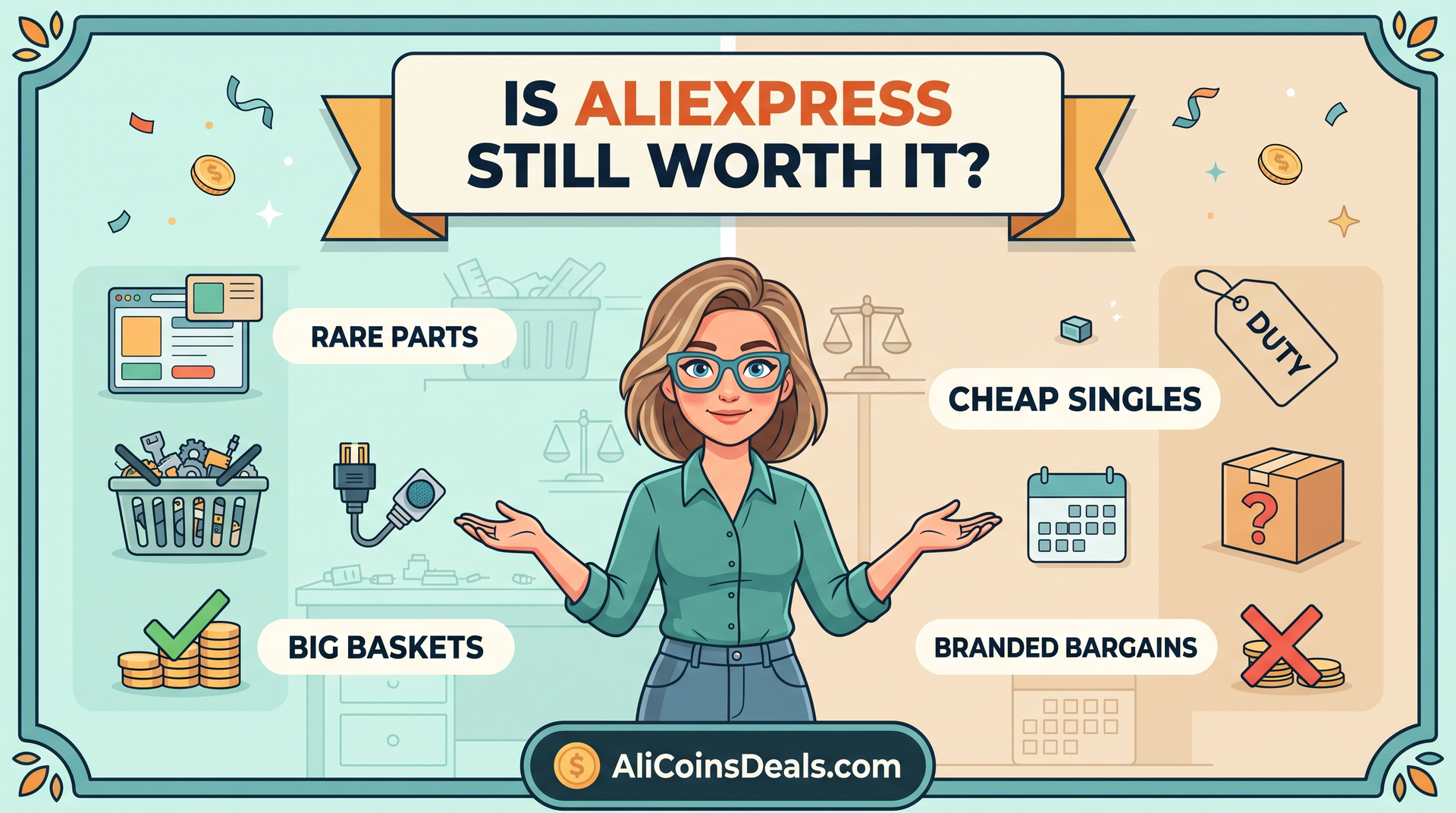
It depends entirely on what you are buying, and the dividing line moved in 2026. Cheap single items lost most of their advantage, because a flat charge per item hurts a €4 purchase far more than a €40 one. Larger baskets of things you cannot easily buy locally still work.
Both the EU and the US closed their low-value import exemptions this year, so the old habit of treating the sticker price as the final price is finished. The good news is that the new arithmetic is simple, and once you can run it you can tell in about ten seconds whether an order is still worth placing.
Key Takeaways
- Since 1 July 2026 the EU charges a flat duty per item on low-value imports, so multi-item baskets of cheap goods attract the charge repeatedly
([European Commission](https://taxation-customs.ec.europa.eu/news/guidance-and-legal-text-temporary-flat-fee-low-value-imports-which-will-apply-until-1-july-2028-2026-06-08_en),2026).
- The US suspended its $800 de minimis exemption indefinitely, for postal shipments from 24 July 2026 and for other transport modes from 24 June 2026 > (Federal Register, 2026).
- Per-item charges punish long baskets of tiny items. Fewer, larger purchases now cost less in charges.
- AliExpress still wins where no local seller exists at all: obscure parts, components, hobby supplies and unbranded goods.
- It stopped winning on cheap branded goods, where the charges land on top of a counterfeit risk a regulator has now formally documented.
What Actually Changed in 2026?
Two separate governments closed the same loophole in the same year. The European Union removed its €150 customs-duty exemption on 1 July 2026 and switched on a temporary flat duty per item on low-value goods (European Commission, 2026).
The United States went further. Its $800 de minimis exemption is now indefinitely suspended: for goods arriving through the international postal network from 24 July 2026 (Federal Register, 2026), and for every other transport mode from 24 June 2026, with those shipments now requiring formal or informal entry procedures (Federal Register, 2026).
The practical translation is the same on both continents. Small parcels are no longer waved through, so a charge now attaches to almost every order, and it is proportionally brutal on the cheapest items.
Does the Maths Still Work?
Run it before you buy, not after. The method takes seconds: take the item price, add the shipping, add any duty and tax shown at checkout, then compare that total against the cheapest local price you can find delivered.
Here is the shape of it, using the EU’s flat duty as an example. Assume a €3 duty per item. On a €30 item, that duty is a tenth of the price, and if the local alternative costs €55 the order still wins comfortably. On a €4 item, the same duty is most of the price again, and a local seller at €8 delivered is now cheaper for something you can have today.
That single comparison explains most of the frustration on the platform right now. Nothing about AliExpress got worse; the charge simply landed hardest on the category people used it for most, which was cheap impulse items. The full charge picture by country is in AliExpress import tax and customs fees by country.
Which Purchases Still Make Sense?
The ones with no real local alternative. That is where AliExpress was always strongest, and charges do not change it because there is nothing to compare against.
- Obscure parts and components. Connectors, sensors, replacement fittings, obsolete cables. Local retail either does not stock them or prices them absurdly.
- Hobby and craft supplies in quantity. Beads, stencils, model parts, fabric trims. A larger single order spreads the fixed charges thinly.
- Unbranded goods where the brand adds nothing. Kitchen tools, storage, cables, tools, garden bits.
- Anything you genuinely cannot source locally. Regional products, niche sizes, discontinued items.
The tactic that follows from a per-item charge is consolidation. Buy fewer, bigger listings, from fewer sellers, less often. Sale periods help here for the same reason, and the timing is in the AliExpress sale calendar.
Which Purchases No Longer Make Sense?
Cheap branded goods, and long baskets of tiny items. Both now carry charges that eat the discount, and the branded case carries a second problem on top.
In July 2026 the European Commission fined AliExpress €550 million for breaching the Digital Services Act, finding it had failed to diligently assess and mitigate the risk of illegal, unsafe and counterfeit products, with many staying online for weeks after detection (European Commission, 2026). That is a regulator’s verdict on the platform’s controls, not a rumour from a review site.
So on a cheap branded item you are now paying import charges for a raised chance of a fake. That trade has stopped being good. If you want branded goods here, buy from the brand’s own store or a vetted listing, as set out in what is AliExpress Brand+, and accept that the price advantage will be modest.
Are the Alternatives Actually Better?
Sometimes, and it is worth checking rather than assuming either way. Local marketplaces and EU or US-warehoused stock avoid the import charges entirely and deliver in days, which is a real advantage on anything commonplace.
The catch is that a lot of that stock is the same goods with a reseller’s margin on top. On generic items, a local listing is frequently an AliExpress product bought in bulk and marked up, so you are paying a premium for speed rather than for quality. That is a fair trade when you need it tomorrow and a poor one when you do not.
The honest summary is that the gap narrowed rather than closed. Comparisons that hold up after the 2026 changes are in AliExpress vs Temu vs Amazon and AliExpress vs Shein.
How Do You Get the Most Out of It Now?
Concentrate your spending. One order of ten items from one seller beats ten orders of one item, because the per-item and per-parcel charges stop multiplying and the shipping is shared.
Then take the discounts seriously, because they now have to do more work than they used to. Coins, store coupons and platform codes all stack in a defined order, and on a larger basket they offset a meaningful part of the new charges. The mechanics are in how to stack AliExpress discounts, and current verified codes are on our AliExpress promo codes page.
Finally, buy in a way that keeps your claim rights intact: Choice or vetted listings, checkout inside the platform, and never confirming receipt early. Those habits matter more when each order carries more cost. The vetting routine is in vet an AliExpress seller in 60 seconds.
Frequently Asked Questions
Is AliExpress still cheaper than Amazon in 2026?
On unbranded and hard-to-find goods, usually yes, especially in a consolidated order. On cheap branded items and small single purchases, often no longer, once import charges and shipping are added. Run the delivered-total comparison per order rather than assuming a general answer.
Do I now pay import charges on every AliExpress order?
Effectively yes in both the EU and the US, because both closed their low-value exemptions in 2026 (European Commission, 2026; Federal Register, 2026). What varies is whether the charge is collected at checkout or by the carrier on delivery.
Is it worth buying cheap small items from AliExpress anymore?
Rarely on their own. A flat per-item charge is proportionally largest on the cheapest goods, so a very cheap item bought alone is the worst case under the new rules. Add them to a bigger order instead of ordering them individually.
Has AliExpress got less safe?
The risk was formally documented rather than newly created. The Commission’s July 2026 decision found real failures in detecting and removing illegal and counterfeit products (European Commission, 2026). Buyer Protection still works, and vetting still works. The safety picture is in is AliExpress safe and legit.
Will prices come down again?
Not from the charges going away. The EU’s flat duty is scheduled as a temporary measure ahead of a wider customs overhaul rather than a rule due to be reversed, and the US suspension is indefinite. Assume the charges are permanent and plan your basket around them.
AliExpress in 2026 is a narrower tool than it was, not a dead one. The per-item charges killed the cheap-single-item habit and dented the case for low-cost branded goods, while leaving the platform’s real strength untouched: things nobody near you sells. Consolidate into fewer larger orders, compare delivered totals rather than sticker prices, and stack the discounts you are entitled to. Do that and it still pays. Ignore the new arithmetic and it quietly stops.
This article is general information, not tax or legal advice. Confirm current rules with the European Commission, US Customs and Border Protection, or your national customs authority before relying on them.
Ready to unlock massive savings?
Don't pay full price on AliExpress. Use our free coin converter to find hidden discounts up to 90% off.